Trench Digging Contractors
Utility Trenching in Cambridge, Ontario
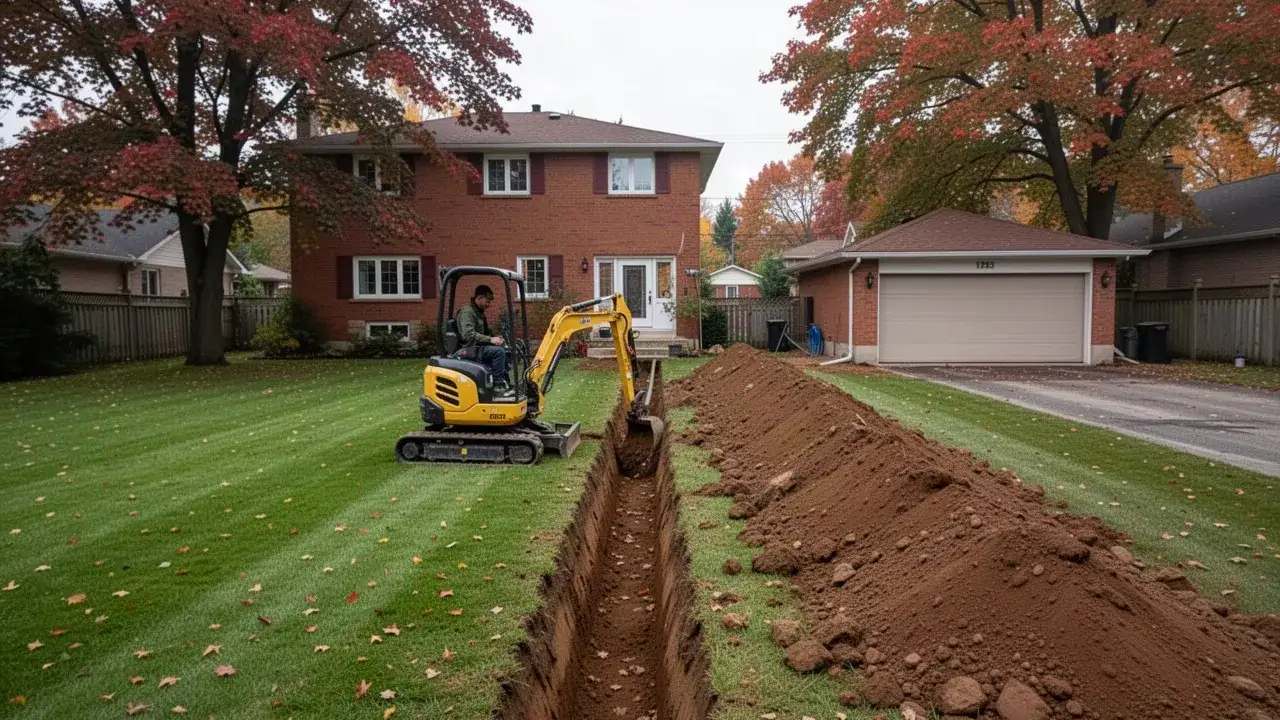
Fennex Cambridge Excavation Pros digs trenches for underground hydro, gas, water and fibre lines across Cambridge and Waterloo Region. We cut a clean, straight trench to the depth your trade needs, bed the line properly and put your yard back together. Our crews have been in the ground around here for more than 40 years.
Homeowners call us to run power to a detached garage, workshop, pool or hot tub. Electricians, plumbers and gas fitters call us so they can spend their day on the wiring and piping instead of the shovel. Builders and commercial clients bring us longer runs for site services, lighting and conduit banks.
Every job starts with locates and follows Ontario's trench safety rules. We are licensed, insured, WSIB covered and hold an IHSA Certificate of Recognition (COR), so the people working in and around your trench are protected and so are you.
Our Utility Trenching Services
Our utility trenching service covers everything between the first locate mark and the last rake of topsoil. We excavate to line and grade, lay or prepare the bedding, leave room for your trade to install and inspect, then backfill in compacted lifts and restore the surface.
We work for property owners directly and as the dig crew for licensed electricians, plumbers and gas fitters. The trade owns the install and the permit; we own a safe, accurate trench that is ready when they arrive.
For water, sewer or storm services that tie into the street, see our sewer, water and storm line excavation service. For rural lots that also need a new septic bed, we plan both digs together with our septic system excavation crew.
Underground Hydro and Electrical Lines
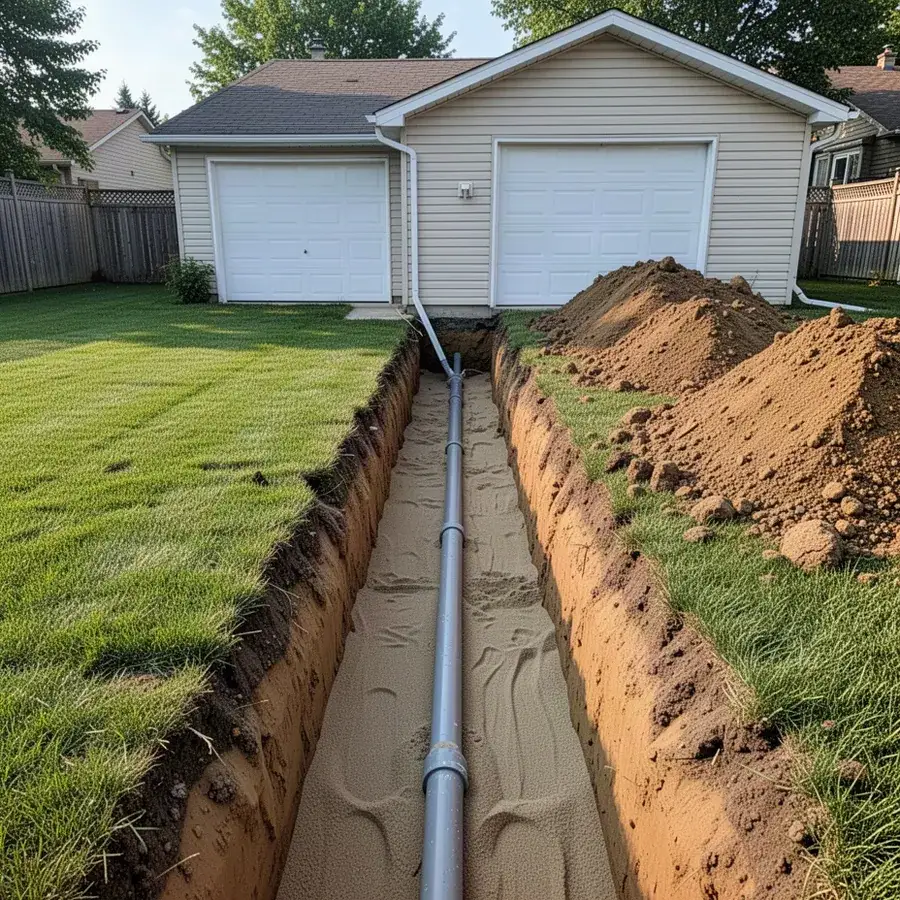
The most common call we get is power to an outbuilding: a detached garage, a backyard workshop, a pool equipment pad or a hot tub. These runs are usually 15 to 60 m (50 to 200 ft) and cross lawn, gardens and sometimes a fence line.
Your electrician chooses direct-burial cable or conduit and tells us the depth. We dig to that spec, keep the bottom free of rocks, and leave the trench open until the Electrical Safety Authority (ESA) inspection is done if one is required before cover.
Gas, Water and Fibre Conduit
We dig for gas lines to pool heaters, barbecues and outbuildings, private water lines to barns and garages, and conduit for fibre or low-voltage cable. Each one is installed and connected by the licensed trade, such as a TSSA-registered gas fitter or a licensed plumber.
We coordinate the dig date with them, match the depth and width they need, and keep different utilities in their own trench or properly separated when they share one.
Trenching for EV Chargers and Standby Generators
Electric vehicles and home standby generators have made trenching a regular part of residential upgrades. A Level 2 charger on a driveway pedestal or in a detached garage usually needs a feed run from the main panel, often under part of the yard.
A natural gas standby generator needs both an electrical connection to a transfer switch and a gas line from the meter. We plan one route that suits both trades, saves your lawn a second excavation and keeps the generator pad accessible.
How Deep Each Utility Needs to Be
Burial depth depends on the utility and the code that governs it. Electrical lines follow the Ontario Electrical Safety Code, gas lines follow CSA B149.1, and water lines must sit below the frost line, which in Waterloo Region is roughly 1.2 m (4 ft).
The licensed trade installing the line sets the final depth, and we dig to it. These are the typical figures we see on residential jobs:
- Electrical, direct-burial cable: typically about 600 mm (24 in) of cover under lawn, deeper under driveways and parking areas.
- Electrical in rigid PVC conduit: typically about 450 mm (18 in) of cover under lawn, more where vehicles cross.
- Private water lines: usually 1.5 to 1.8 m (5 to 6 ft) of cover so the line never freezes, or insulated where that depth is not possible.
- Gas piping: depth and tracer wire as specified by your gas fitter under CSA B149.1.
- Fibre and low-voltage conduit: usually shallower, at the depth the provider or installer specifies.
If a trench has to cross another buried line, we expose the crossing by hand and confirm the clearance before the machine goes near it.
Trenching Equipment: Mini Excavators vs Chain Trenchers
A mini excavator is the better tool for most residential trenches in Cambridge and Kitchener, because our ground is full of glacial till, cobbles and the odd boulder. A chain trencher is faster and narrower in clean, stone-free soil, but it stalls and wanders when it meets rock.
A compact excavator with a 300 mm (12 in) trenching bucket digs a clean trench at any depth, can lift out rocks and old concrete, and lets us expose crossings carefully. Rubber tracks and a narrow body mean it fits through many backyard gates and leaves less lawn damage than a wheeled machine. Our mini excavator and Bobcat services page explains access widths in more detail.
Chain trenchers cut a 100 to 150 mm (4 to 6 in) slot with minimal spoil, which suits long, shallow runs of cable or irrigation in sandy loam. We will tell you honestly which machine suits your ground and run, and plan the job around it.
Our Trench Digging Process
Good trench digging is mostly preparation and clean-up. These four stages are the same whether the run is 10 m to a hot tub or 200 m across a commercial lot.
- 01
Ontario One Call and Private Locates
We request public locates through Ontario One Call before every dig, as required by the Ontario Underground Infrastructure Notification System Act. Standard requests are free, and utility owners have up to five business days to respond.
Public locators only mark lines up to the meter, so we also arrange a private locate when there may be owner-installed lines, such as an existing garage feed, a gas line to a barbecue, irrigation or a well line.
- 02
Excavating to Line and Grade
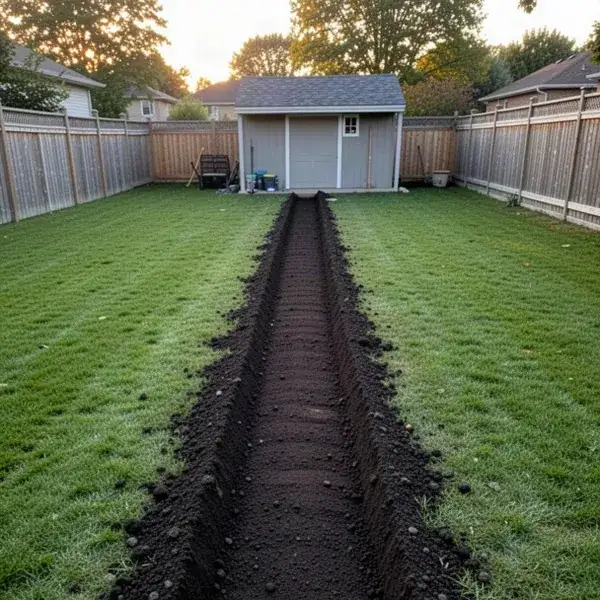
We string or paint the route, strip and set aside sod where it can be reused, and dig a straight trench with a level bottom at the specified depth. Spoil is kept at least 1 m back from the edge, as O. Reg. 213/91 requires.
Where the trench crosses marked lines, we hand dig or use careful bucket work to expose them before continuing.
- 03
Bedding, Conduit and Warning Tape
We place 75 to 150 mm (3 to 6 in) of sand bedding so the cable or pipe sits on a smooth, stone-free base. Your trade then lays the line or conduit and completes any required inspection.
After a layer of sand or screened fill over the line, a coloured warning tape goes in roughly 300 mm (12 in) above it, so anyone digging later hits tape before they hit the utility.
- 04
Backfill and Lawn Restoration
We backfill in lifts and compact each one with a plate tamper or rammer so the trench does not sink after the first spring thaw. Under driveways or walkways, the top layer is compacted Granular A rather than native soil.
Finish work is screened topsoil, raked level and seeded, or the sod we lifted at the start relaid where it is still in good shape.
Trench Safety and Ontario Regulation 213/91
Any trench wall deeper than 1.2 m (4 ft) that a worker may enter must be sloped, shored or protected by a trench box under Ontario Regulation 213/91 for Construction Projects. That depth catches most water line trenches and some electrical runs under driveways.
The regulation sorts soil into Types 1 to 4, and the type decides how far the walls must be laid back. Waterloo Region soils range from stiff clay till that may hold a vertical wall briefly to loose sand and gravel on the moraines that will not, so we classify the soil on site instead of assuming.
Our COR certification from the Infrastructure Health and Safety Association means our safety program has been audited against a provincial standard. For you, that means fewer surprises, no unprotected workers in a deep trench, and a contractor that a general contractor or commercial client can approve without hesitation.
Trenching Cost per Foot
Most residential utility trenching in the region falls roughly between $20 and $60 per linear foot, depending on depth and ground conditions. Short runs often have a minimum charge to cover mobilizing the machine, and the firm number always comes from a free site visit.
These factors move the price the most:
- Length and depth: a 600 mm power trench costs far less per foot than a 1.8 m water line trench that needs sloping or a trench box.
- Soil and rock: cobble-heavy till, buried concrete or bedrock slow the dig and may need a hydraulic breaker.
- Access: narrow gates, decks, retaining walls and mature trees can mean smaller equipment and more hand work.
- Crossings: every existing line we must expose by hand adds time.
- Surfaces: saw cutting and patching asphalt, concrete or interlock costs more than restoring lawn.
- Bedding and restoration: imported sand, Granular A, topsoil and sod are priced by quantity.
Your quote lists what is included, such as locates, bedding, backfill and restoration, and what could change the price, such as rock or unmarked obstructions.
Where We Provide Utility Trenching
We provide utility trenching from our Cambridge yard to homes, farms and businesses within about a 30-minute drive of Cambridge. Choose your community for local permit, soil and neighbourhood details.
Utility Trenching FAQs
How deep does an underground electrical line need to be?
Under the Ontario Electrical Safety Code, residential direct-burial cable is typically buried with about 600 mm (24 in) of cover, and cable in rigid PVC conduit with about 450 mm (18 in). Areas under driveways or other vehicle traffic need more depth.
Your electrician confirms the exact figure for the cable type and location, and we dig to their spec.
How much does trenching cost per foot?
Typical residential trenching in Waterloo Region runs about $20 to $60 per linear foot. Shallow electrical runs in open lawn sit at the low end, while deep water line trenches, rocky ground and hard-surface restoration push it higher.
We give a fixed written quote after a free site visit.
Who arranges locates before trenching?
We do. We file the Ontario One Call request so public utilities such as hydro, gas, telecom and municipal water mark their lines.
Lines you own past the meter are not marked by public locators, so we arrange a private locate when the property may have them. The private locate is usually a small separate cost that we list in the quote.
Can you trench under a driveway or walkway?
Yes. The usual method is to saw cut a narrow strip, excavate, install the line, then rebuild the base with compacted Granular A and patch the surface.
Where you want the surface left untouched, a directional boring contractor can bore underneath and we trench to each side. We will price both options so you can compare.
Get a Trenching Quote
Tell us what you are running, where it starts and where it ends, and we will walk the route with you or your trade. You get a written quote that covers locates, digging, bedding, backfill and restoration, with no guesswork about the extras.
Replacing a sewer or water service at the same time? Ask about our sewer, water and storm line excavation so both lines are planned in one dig. We serve properties across Cambridge, Kitchener, Waterloo and Guelph.
- Fennex Cambridge Excavation Pros
- 725 Briardean Rd, Cambridge, ON N3H 4R6
- +1 226-894-8631
- info@fennexexcavation.ca
- Mon to Sat 7:00am to 9:30pm
Sun 9:00am to 9:00pm