Concrete Removal Contractors
Concrete Removal and Breaking in Cambridge, ON
Fennex Cambridge Excavation Pros breaks and removes concrete of every size across Cambridge and Waterloo Region, from a single cracked walkway to reinforced commercial slabs. We have spent more than 40 years running excavators and hauling material in this area, and concrete removal is a natural part of that work.
Homeowners call us before a new driveway, patio or interlock install. Landscapers, general contractors and commercial property owners call us to clear slabs, curbs, footings and pads so the next trade can start on schedule.
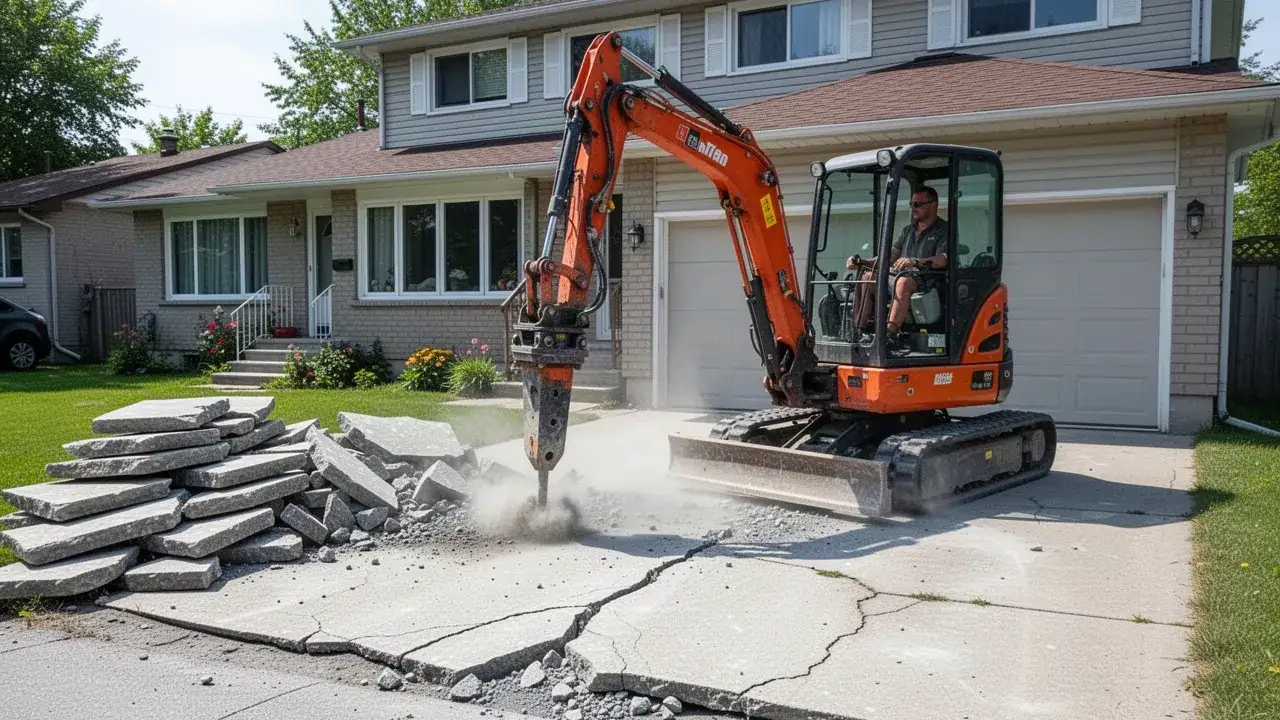
We bring the right tool for each slab: a hydraulic breaker on an excavator or skid steer for most outdoor work, handheld breakers where a machine cannot reach, and diamond saws for clean edges. Clean concrete goes to recycling, not landfill.
Our Concrete Breaking and Removal Services
We remove residential and commercial concrete and leave the area ready for what comes next. A standard removal includes saw cutting where needed, breaking, loading, haul-away to a recycler and rough grading of the base.
We serve homeowners and contractors throughout our Cambridge excavation service area and the rest of Waterloo Region.
Driveways, Walkways and Patios
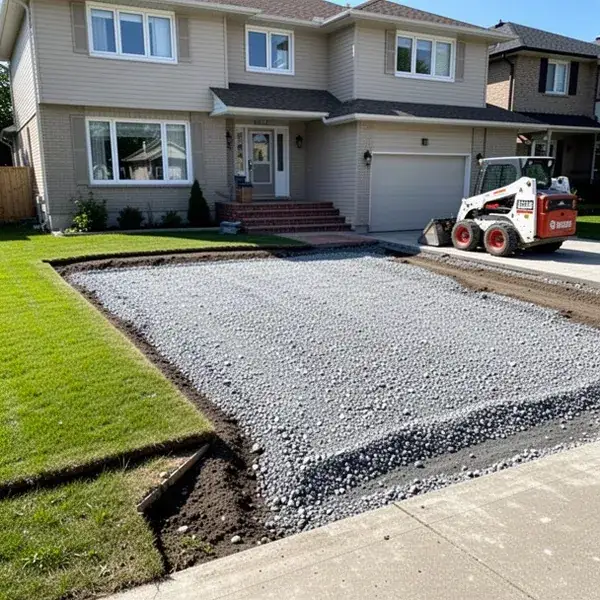
Driveways, walkways and patios are the most common residential removals. Most are 100 mm (4 in) slabs with welded wire mesh, poured over a gravel base.
Removal usually takes a few hours to one day. When the base needs rebuilding for new concrete, asphalt or pavers, our driveway excavation and preparation service takes it from there.
Garage Floors and Basement Slabs
Garage floors and basement slabs come out for drainage repairs, plumbing replacement, basement lowering or a new floor. Interior work relies on handheld electric breakers, with debris carried out through doors or basement windows.
Dust control matters indoors. Cutting is done wet or with dust extraction, and the work area is sealed off to keep silica dust out of the rest of the house.
Foundations, Footings and Retaining Walls
Foundations, footings and concrete retaining walls are the heaviest removal jobs, since they are thick and usually reinforced with rebar. Poured basement walls are commonly 200 to 250 mm (8 to 10 in) thick, and footings are wider still.
These jobs need a larger excavator with a hydraulic breaker, plus a shear or torch to cut steel. Full building foundations usually come out as part of a house demolition project.
Commercial Slabs, Curbs and Pads
Commercial work includes loading dock aprons, equipment pads, sidewalks, curbs and gutters, and sections of warehouse floor. These slabs are often 150 to 200 mm (6 to 8 in) thick with heavier reinforcement.
Work can be phased around business hours to keep customers and deliveries moving. Our commercial excavation services cover the site work that follows removal.
Breaking Methods: Hydraulic Breakers, Jackhammers and Saw Cutting
The right breaking method depends on slab thickness, reinforcement, access and how close the work is to things that must stay intact. Most jobs use a combination of all three.
Hydraulic breakers, also called hoe rams, mount on a mini excavator, larger excavator or skid steer and deliver hundreds of heavy blows per minute. They are the fastest option for driveways, patios and foundations, and they keep workers out of the impact zone.
Handheld jackhammers, electric or pneumatic, suit small areas, interior slabs, steps and spots a machine cannot reach. They are slower and harder on the operator, so they are used only where they are the right fit.
Saw cutting with a walk-behind diamond saw creates a straight, clean edge where old concrete meets concrete that stays. Cutting is done wet to control respirable crystalline silica, a designated substance under Ontario's Occupational Health and Safety Act.
Near houses, noise and vibration are the main trade-offs. A breaker on a lighter machine, working inside a saw-cut perimeter, keeps vibration away from foundations, basement walls and buried pipes.
Our Concrete Removal Process
Concrete removal follows five steps, and a typical single driveway is finished in under a day. Larger or heavily reinforced jobs take longer.
- 01
Locates and Checking for Buried Lines
Every job starts with free utility locates through Ontario One Call, which Ontario law requires before breaking ground. Gas, hydro, cable and water services often run under old driveways and walkways.
Public locates do not cover private lines, so we also ask about lines to garages, hot tubs, lamp posts, irrigation and natural gas barbecues. A private locator marks those where needed.
- 02
Saw Cutting Clean Edges
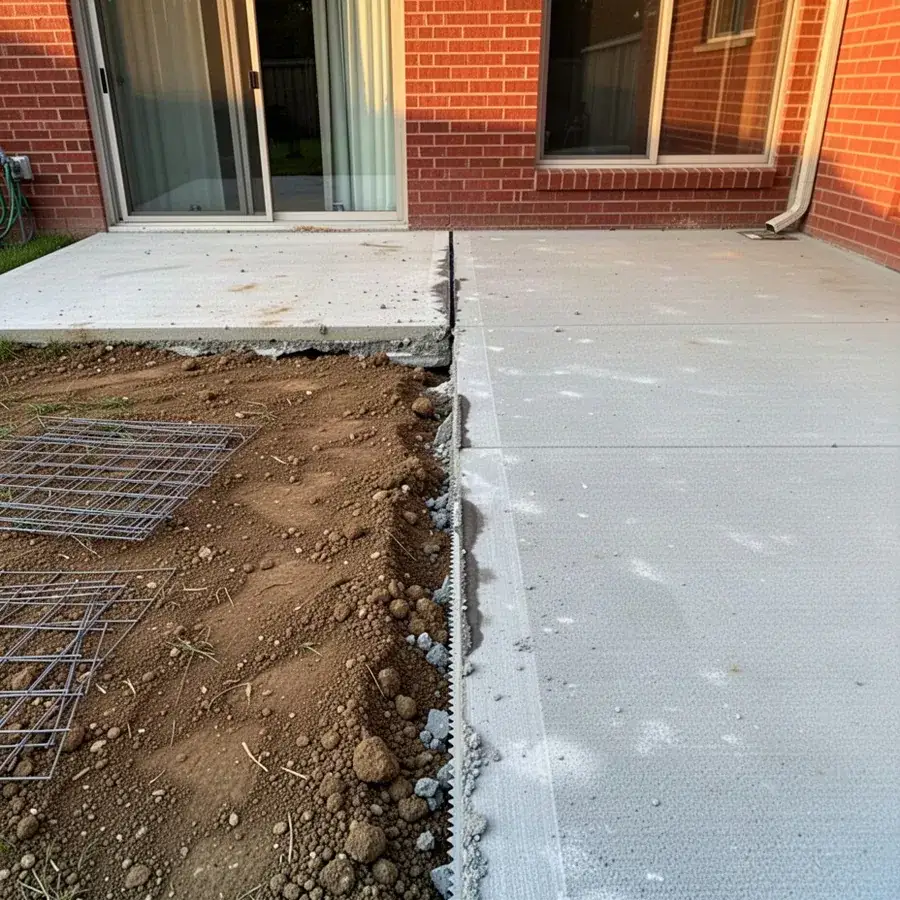
When only part of a slab is coming out, we saw cut a straight line first so the concrete that stays has a clean, square edge. Without a cut, breaking can crack the remaining slab well past the removal line.
Residential slabs are cut to full depth wherever possible, so the break follows the cut exactly.
- 03
Breaking and Loading
A hoe ram on an excavator or skid steer breaks the slab into pieces that a bucket or grapple loads straight into a dump truck. Breaking starts at a free edge, which lets the concrete crack away instead of absorbing the blows.
Wire mesh and rebar are pulled out or cut as we go so loads stay manageable.
- 04
Haul-Away to Recycling
Clean concrete is hauled to a recycling yard, where it is crushed and screened into recycled aggregate. Keeping loads free of soil, wood and garbage is what makes that possible.
A tandem dump truck carries about 12 tonnes, which is roughly the broken concrete from 50 m² (540 sq ft) of a 100 mm (4 in) slab.
- 05
Grading for What Comes Next
Once the concrete is out, we rough grade the base for its next use. For new concrete or pavers, that usually means removing contaminated material and topping up with Granular A compacted with a plate tamper or roller.
For lawns, we remove the gravel base and place topsoil ready for sod or seed. Larger reshaping is handled through our grading and levelling service.
Reinforced Concrete: Rebar, Wire Mesh and Thick Slabs
Reinforcement and thickness are the two biggest reasons one concrete job takes twice as long as another of the same size. Steel holds broken pieces together, and thicker slabs absorb more energy before they crack.
Welded wire mesh is common in residential driveways and patios. It keeps broken pieces tied together, so the operator has to tear the mesh apart while loading, which slows production.
Rebar, typically 10M or 15M bars in Canadian construction, shows up in garage aprons, structural slabs, footings, foundation walls and commercial pads. Heavily reinforced concrete needs a larger breaker plus a shear or torch to cut the steel, which is then sorted for scrap.
Thickness matters as much as steel. A 100 mm (4 in) residential slab breaks quickly, while a 200 mm (8 in) commercial slab can take several times the effort per square metre.
Old slabs often hide surprises, such as a second pour over the first, thickened edges or buried footings from a former structure. We check thickness at an edge or test cut before quoting, so the price reflects what is really there.
Where Your Removed Concrete Ends Up
Clean concrete we remove goes to a recycling facility, not a landfill. There it is crushed, screened and stripped of steel to become recycled concrete aggregate.
Recycled aggregate is widely used as granular base under roads, driveways and parking lots. Ontario's OPSS 1010 aggregate specification permits recycled concrete in Granular A and Granular B for many uses, making it a direct substitute for quarried stone.
Recycling cuts landfill tonnage and reduces demand on aggregate pits and quarries. It is also usually cheaper than landfill disposal, which helps keep your removal cost down. Steel from rebar and mesh goes to scrap metal recyclers.
Concrete Removal Cost Factors
Concrete removal cost depends on area, thickness, reinforcement, access and disposal. As a general Waterloo Region range, most residential slab removals run about $4 to $10 per square foot, and small jobs carry a minimum charge to cover equipment and trucking.
These ranges are a guide only. We confirm a firm price after a free site visit.
- Area: total square metres, which sets breaking time and the number of truckloads.
- Thickness: 100 mm residential slabs versus 150 to 200 mm commercial slabs and footings.
- Reinforcement: wire mesh, rebar spacing and bar size.
- Access: backyard patios behind the house need compact equipment and more trips, and interior slabs are the most labour-intensive.
- Saw cutting: linear metres and depth of cut for partial removals.
- Disposal: number of loads and distance to the recycler; loads mixed with soil or garbage cost more.
- Base work and restoration: Granular A top-up, compaction, topsoil or sod.
Where We Provide Concrete Breaking and Removal
We provide concrete breaking and removal from our Cambridge yard to homes, farms and businesses within about a 30-minute drive of Cambridge. Choose your community for local permit, soil and neighbourhood details.
Concrete Removal FAQs
How much does concrete removal cost per square foot?
Most residential concrete removal in Waterloo Region costs about $4 to $10 per square foot, depending on thickness, reinforcement and access. A standard double driveway of about 55 m² (600 sq ft) often lands between $2,400 and $6,000.
Small jobs carry a minimum charge, and saw cutting or base work may be priced separately.
Can you remove part of a driveway or patio?
Yes. We saw cut a straight line between the section coming out and the section staying, then break and remove only the marked area.
This is common for widening a driveway, replacing a sunken section, or making room for a garden bed or new steps.
Do you recycle the concrete you remove?
Yes. Clean concrete goes to a recycling yard where it is crushed into recycled aggregate for road and driveway base, and rebar and mesh go to scrap metal recyclers.
Only concrete mixed with soil or waste that a recycler will not accept goes to landfill.
How long does it take to remove a concrete driveway?
Removing a typical single concrete driveway usually takes less than a day, including loading and haul-away. A double driveway or heavily reinforced slab may take one to two days.
Regrading the base for a new surface can usually follow the same day.
Book Your Concrete Removal
Looking for concrete removal near you in Cambridge, Kitchener, Waterloo or Guelph? Tell us what needs to go and what is going in its place, and we will price the removal and base work together after a free site visit.
Replacing a driveway? Our driveway excavation and preparation team can build the new granular base right after removal.
- Fennex Cambridge Excavation Pros
- 725 Briardean Rd, Cambridge, ON N3H 4R6
- +1 226-894-8631
- info@fennexexcavation.ca
- Mon to Sat 7:00am to 9:30pm
Sun 9:00am to 9:00pm