Inground Pool Digging Contractors
Inground Pool Excavation in Cambridge, Ontario
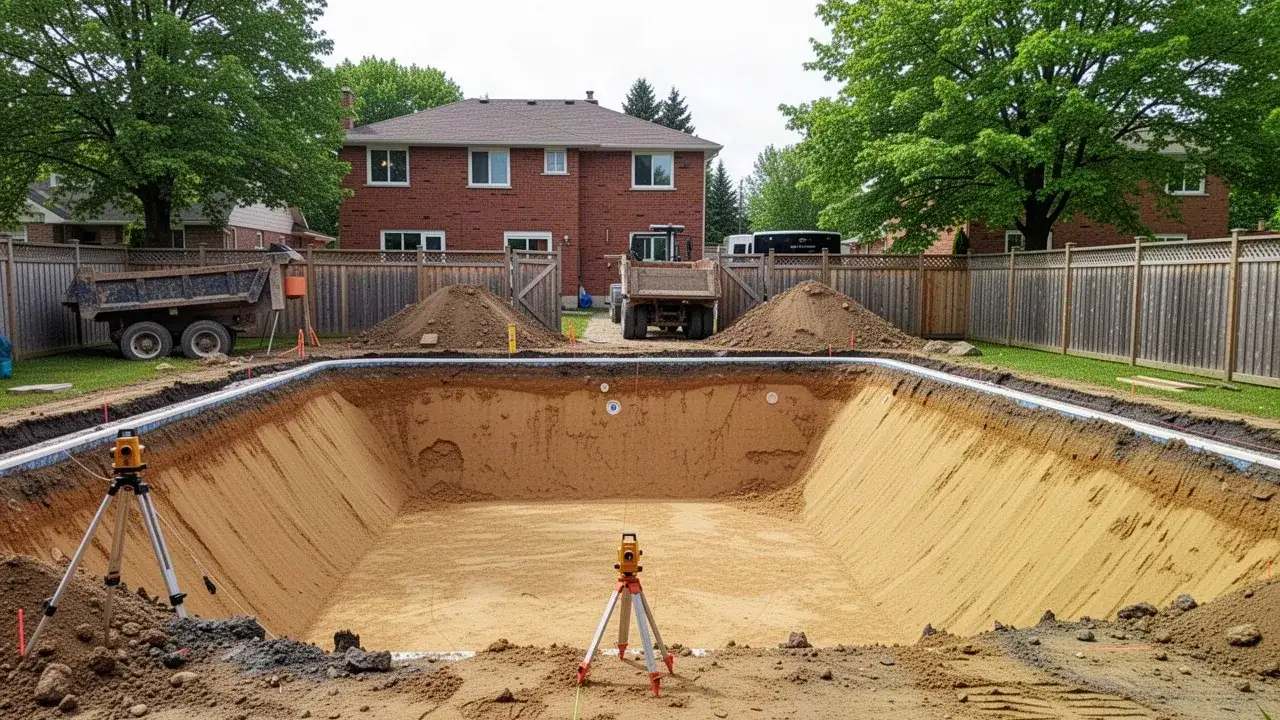
Fennex Cambridge Excavation Pros digs inground pools for pool builders and homeowners across Cambridge, Kitchener, Waterloo and Guelph. We lay out the hole, cut it to the builder's dimensions, shape the deep end and either haul the soil away or regrade it on site.
Most of our pool work happens in fenced suburban backyards with one narrow way in, where the soil has to come out without wrecking the lawn, the driveway or the neighbour's gardens. Rural lots in Puslinch and Wilmot give more room but often bring stonier ground.
Over more than 40 years of digging in this region, we have met every condition a pool hole can throw at you. That includes the sticky clay that holds water, the sand and gravel that slumps, the fieldstone boulders left by glaciers and groundwater that rises as soon as you go below 1.5 m.
Our Pool Excavation Services
We handle the full earthwork side of an inground pool: layout, excavation to the pool builder's spec, deep-end shaping, over-dig for walls and forming, soil removal and backfill once the pool is set. You can hire us directly or have your pool company book us as their excavation subcontractor.
Each dig is checked with a rotating laser level against a fixed benchmark, so the floor and deep end match the drawings. Once the pool is in, our backfilling crews place and compact the stone around the walls.
Digging for Pool Installers
Pool companies need a hole that is the right size, at the right depth, on the day their crew and the shell arrive. We dig from your layout sheet and cut list, confirm grades with your installer and keep the spoil out of the way of the walls and plumbing.
Our hours run late into the evening and on Sundays, which makes it easier to fit a dig into a tight installation schedule.
Homeowner-Direct Pool Digs
Some owners manage their own build or install a kit pool, such as a steel-wall vinyl liner package. We work from the kit manufacturer's excavation drawing and walk you through what needs to be ready before the machine arrives.
That includes the pool permit, the fence plan and a decision on where the soil goes.
Excavating for Fibreglass, Vinyl Liner and Concrete Pools
Each pool type needs a different hole. A fibreglass shell needs a precise, close-fitting cut, a vinyl liner pool needs room around the walls, and a concrete pool needs the most over-dig for forming and spraying.
Knowing which pool you are installing before we arrive is essential, because it sets the dig size, the base material and the backfill.
Fibreglass Pool Excavation
A fibreglass pool is a one-piece shell, so the hole has to mirror its shape with about 300 mm (1 ft) of clearance around the sides. The floor is dug slightly low and topped with a screeded base of clear stone or the bedding material the manufacturer specifies.
Many builders also want a vertical sump or well point dug beside the deep end. It lets them check and pump groundwater so the empty shell is never pushed up.
Vinyl Liner Pool Excavation
Vinyl liner pools are built from steel or polymer wall panels, so we over-dig about 600 mm (2 ft) beyond the walls for bracing and plumbing. The shallow end is cut flat to the wall height, then a hopper or sloped deep end is shaped to the liner pattern.
The floor is finished by the installer with a trowelled base, so we leave a firm, smooth subgrade without soft spots.
Concrete and Gunite Pool Excavation
Concrete pools, whether formed and poured or sprayed as gunite or shotcrete, need the widest over-dig to give room for rebar and forming. Nearly all of the soil leaves site, since the walls fill most of the hole.
These digs are usually deeper and more custom, with steps, benches and diving wells cut to the pool designer's plan.
Getting Equipment Into Your Backyard
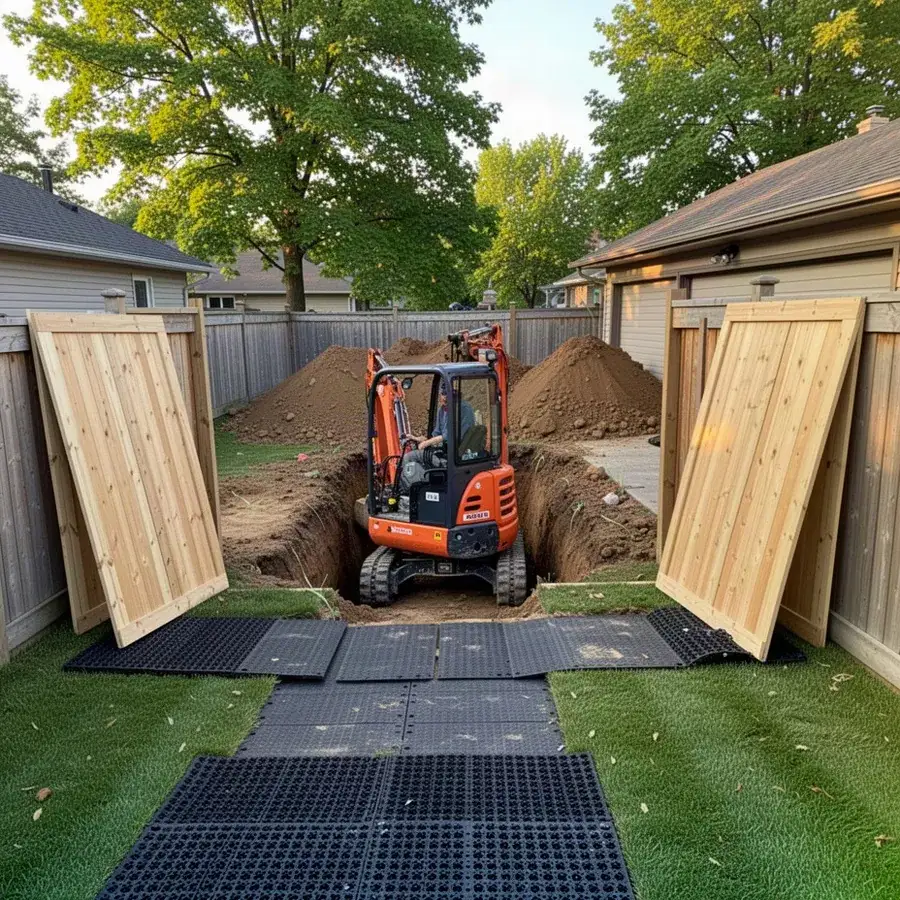
Access is the first thing we check on a pool site, because the gap between the house and the lot line decides which machine can dig. As a guide, a 1.0 m (40 in) opening fits only a micro excavator, around 1.5 m (5 ft) fits most mini excavators and compact track loaders, and 2.4 to 3 m (8 to 10 ft) lets a larger excavator in.
Removing one or two fence panels is often the simplest way to widen a gate, and we refit them when we leave. Composite ground protection mats spread the machine's weight over lawns, interlock and septic-free areas so tracks do not rut the yard.
A smaller machine takes longer and may need a skid steer or track loader to shuttle soil to the trucks. When the access is tight, our mini excavator and Bobcat services are the right tools for the job.
How a Pool Dig Works
A typical residential pool dig is done in one to two days, followed by backfill once the pool is set. Here is the sequence on most jobs.
- 01
Locates and Layout
We request free utility locates through Ontario One Call at least a week ahead, which covers public gas, hydro, water and communications lines. Private lines are not included, so gas to a BBQ, power to a shed or hot tub and irrigation lines need a private locator.
Your pool builder or our crew then paints the pool outline and over-dig line, and sets a benchmark for depth.
- 02
Digging the Shell and Deep End
The excavator strips topsoil first and stockpiles it separately for your landscaping. We then dig the shallow end to depth, shape the transition and cut the deep end, checking with the laser every few buckets.
Final trimming is done carefully, since over-digging the floor and refilling with loose soil leaves a soft spot under the pool.
- 03
Soil Removal or On-Site Grading
A common 16 by 32 ft (4.9 by 9.8 m) vinyl liner pool produces roughly 100 to 120 m³ (130 to 160 cubic yards) of soil once the over-dig is included. Dug soil swells, so that usually means about 10 to 12 tri-axle loads if it all leaves site.
Some owners keep part of it to raise a low yard, build a berm or level the pool deck area. We tell you on the site visit how much can stay without causing drainage problems.
- 04
Backfill Around the Finished Pool
After the walls or shell are set and levelled, we backfill around the pool in lifts as it is filled with water, so pressure stays balanced on both sides. Most installers specify 19 mm clear stone for fibreglass shells and clear stone or approved granular for vinyl liner walls.
Native clay is never pushed back against pool walls, because it holds water, expands when frozen and can bow the panels.
Groundwater, Clay and Rock in Pool Digs
Groundwater, clay and buried boulders are the three conditions that most often slow a pool dig in Waterloo Region. Spotting them early protects your schedule and your budget.
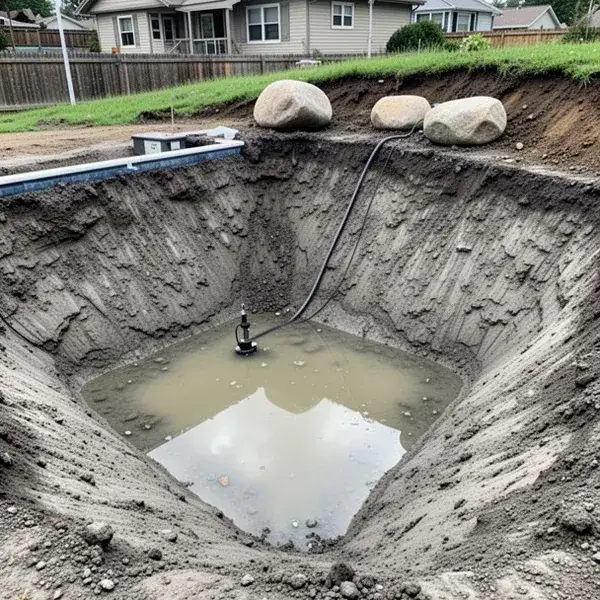
Lots near the Grand and Speed rivers in Galt, Preston and Hespeler can hit the water table within 1.5 to 2 m in spring. We pump the hole with a submersible pump, and builders may add a hydrostatic relief valve or a permanent well point so the empty pool is never lifted.
Clay subdivisions hold water like a bathtub after rain, and the walls go greasy and slump if left open. Glacial till across the region also hides fieldstone boulders, which we pull out with the excavator or break when they are too big to lift.
Pool Excavation Cost Factors
As a general guide, most residential pool digs in Waterloo Region fall between about $3,000 and $8,000, with haul-away and difficult access pushing jobs higher. Your firm price comes from a free site visit where we measure access and look at the soil.
- Pool size and depth: more volume means more machine time and more truckloads.
- Access: a narrow side yard means a smaller machine, more hours and sometimes a second machine to carry soil out.
- Soil type: clean sand digs fast, while wet clay and dense till take longer to trim.
- Rock and boulders: large stones add breaking or extra handling time.
- Haul-away: trucking and disposal fees depend on load count and distance to an approved receiving site.
- Groundwater: pumping and extra stone add cost when the hole fills.
Pool Permits, Setbacks and Fence Bylaws
Every inground pool in Cambridge, Kitchener and Waterloo needs a pool enclosure permit and a compliant fence before it is filled. In Cambridge, pools deeper than 0.6 m (24 in) must be enclosed by a fence at least 1.5 m (5 ft) high with self-closing, self-latching gates.
Each municipality's zoning by-law also sets minimum distances between the pool and the property lines, the house and any easements. On rural lots in Puslinch, Wilmot or Woolwich, the pool and the machines that dig it must stay well clear of the septic tank and leaching bed.
We check the approved site plan before digging and stake to it. If your home is in Waterloo, our Waterloo excavation crews work to that city's enclosure rules every season.
Where We Provide Pool Excavation
We provide pool excavation from our Cambridge yard to homes, farms and businesses within about a 30-minute drive of Cambridge. Choose your community for local permit, soil and neighbourhood details.
Pool Excavation FAQs
How long does it take to dig an inground pool?
Usually one to two days for a typical residential pool. Tight access, clay, rock or groundwater can add a day.
How much soil comes out of a pool excavation?
A 16 by 32 ft vinyl liner pool yields roughly 100 to 120 m³ (130 to 160 cubic yards) including over-dig. That is about 10 to 12 tri-axle loads once the soil swells.
How wide does my gate need to be for an excavator?
About 1.5 m (5 ft) fits most mini excavators, while a 1.0 m (40 in) gap limits us to a micro machine. Removing a fence panel often solves the problem.
Do you haul away the soil after digging a pool?
Yes, we can haul it all away, or regrade part of it on your property where it will not create drainage problems. We stockpile topsoil separately either way.
Schedule Your Pool Dig
Pool builders, send us your layout and install date and we will lock in the dig. Homeowners, book a free site visit and we will check access, soil and haul-away so there are no surprises.
Need a small machine for a tight yard or the landscaping afterward? Our mini excavator and Bobcat services cover patios, pool decks and final grading too.
- Fennex Cambridge Excavation Pros
- 725 Briardean Rd, Cambridge, ON N3H 4R6
- +1 226-894-8631
- info@fennexexcavation.ca
- Mon to Sat 7:00am to 9:30pm
Sun 9:00am to 9:00pm