Foundation Backfill Contractors
Backfilling Services in Cambridge, ON
Fennex Cambridge Excavation Pros backfills new foundations, utility trenches and pool excavations for builders, contractors and homeowners across Cambridge and Waterloo Region. We supply the right fill, place it in compacted lifts and shape the final grade so water runs away from your walls.
Many of our backfill calls come at the end of someone else's work: a builder whose walls just passed the waterproofing inspection, or a homeowner whose foundation was dug out for new membrane and weeping tile. Either way, the hole has to be closed without cracking, pushing or soaking the wall that was just fixed.
After more than 40 years of local excavation, we have seen what careless backfill does. Settled flowerbeds, sunken walkways, bowed block walls and wet basements are usually backfill failures, and every one of them is preventable.
Our Backfilling Services
Our backfilling service covers material supply, placement, compaction and rough grading for foundations, trenches and pools. We handle the whole sequence so one crew is accountable for how the fill performs a year later.
Foundation Backfill
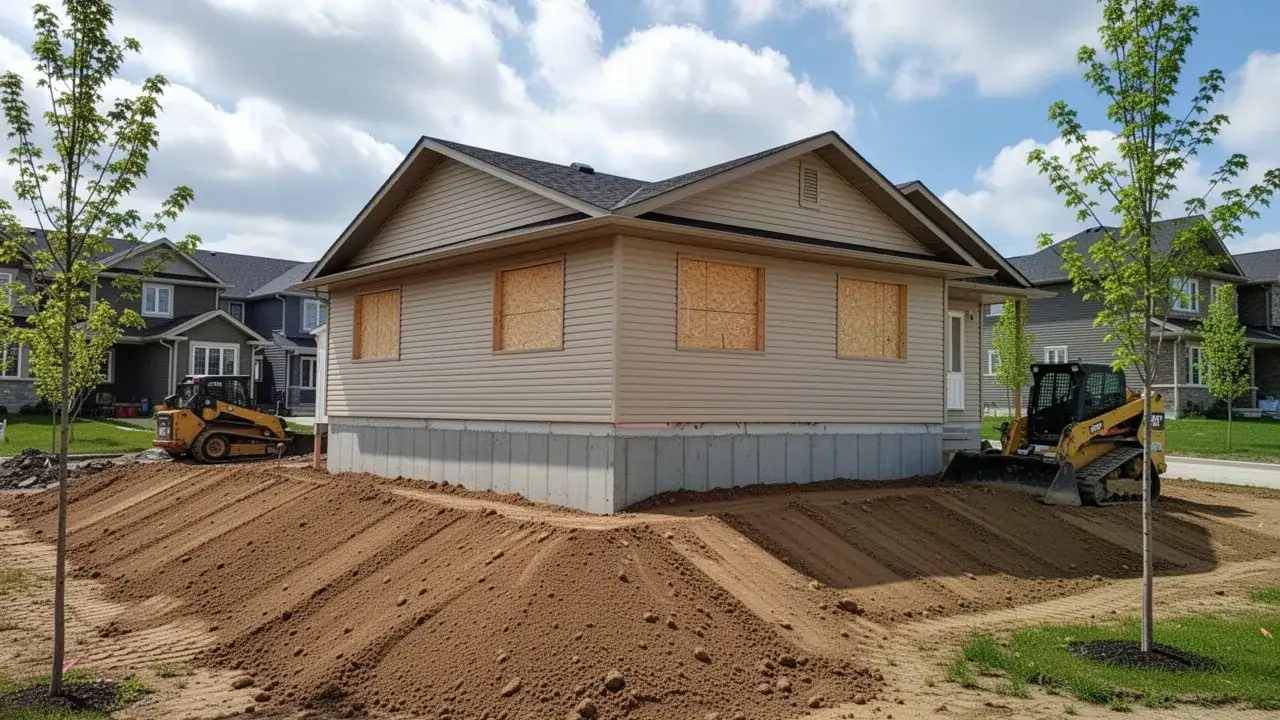
Foundation backfill goes in only after the dampproofing or waterproofing and the weeping tile have been inspected. We protect the membrane, keep the drainage stone over the tile clean and bring the fill up evenly on all sides of the house.
This applies to new homes, additions and existing houses that were dug out for exterior waterproofing or weeping tile replacement.
Trench and Utility Backfill
Trench backfill has two parts: bedding and cover material placed carefully around the pipe, and general backfill above it. Sewer and water pipes such as PVC SDR 28 or SDR 35 typically sit on Granular A or sand bedding, with cover carried 300 mm (12 in) above the crown before heavier compaction begins.
Under driveways and roads, the whole trench is filled with compacted granular to stop the surface from sagging. This is the final stage of our utility trenching service for water, sewer, gas and electrical runs.
Pool and Excavation Backfill
Around a new inground pool, backfill must be placed evenly against the walls, often with clear stone or granular, to avoid pushing panels out of line. Vinyl liner and fibreglass pools each have their own backfill instructions from the manufacturer, and we follow them.
We also fill the hole left when an old pool is taken out, compacting in lifts so the area can carry a lawn, a patio or even a future addition. Our swimming pool removal service covers the demolition side of that job.
What Is Backfill and Why It Matters
Backfill is the soil or granular material placed back into an excavation after a foundation, pipe or structure has been built in it. It supports the structure, carries the surface above it and controls where groundwater goes.
Poor backfill fails in three predictable ways. Loose fill settles, leaving a dip that funnels water straight against the foundation, and wet or heavy clay fill pushes on the wall with frost and water pressure until block walls crack or bow.
Fill full of debris also rots or shifts over time, opening voids under walkways and steps. Good backfill costs a little more on the day and saves much larger repairs later.
Choosing Backfill Material
The best backfill material depends on the soil you already have, how wet the site is and what will sit on top. Free-draining granular is the safest choice against a basement wall, but clean native soil often works and costs far less.
Native Soil
Native soil is the material that came out of the hole, and it is the cheapest backfill because nothing has to be bought or hauled. Sandy and gravelly soils, common on the moraines around Cambridge, usually make good backfill.
Heavy clay, wet silt, topsoil and anything with roots, concrete chunks or construction debris should not go against a foundation. The Ontario Building Code also bars boulders larger than 250 mm (10 in) in the backfill close to the wall.
Granular B and Sand
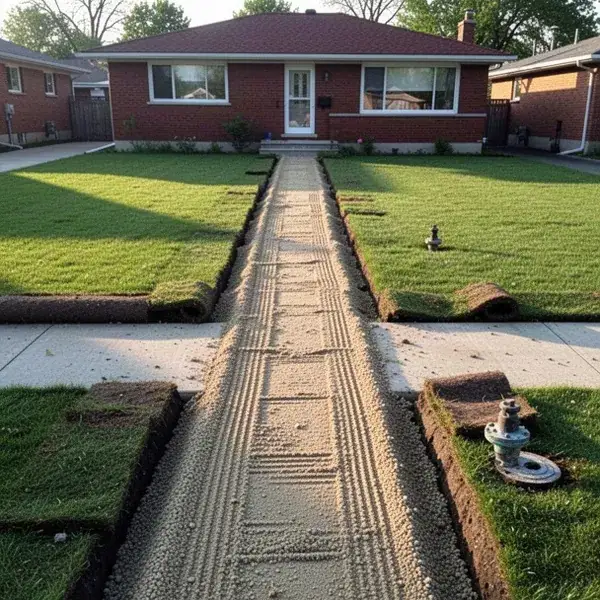
Granular B is a pit-run sand and gravel blend specified under OPSS 1010, and it drains freely and compacts well. It is our usual choice where native soil is clay, where a garage slab, porch or walkway will sit on the fill, or under driveways crossing a trench.
Clean sand also drains well and works around pipes and in tight spaces. It needs good compaction and should be capped near the surface so it does not wash out.
Clear Stone
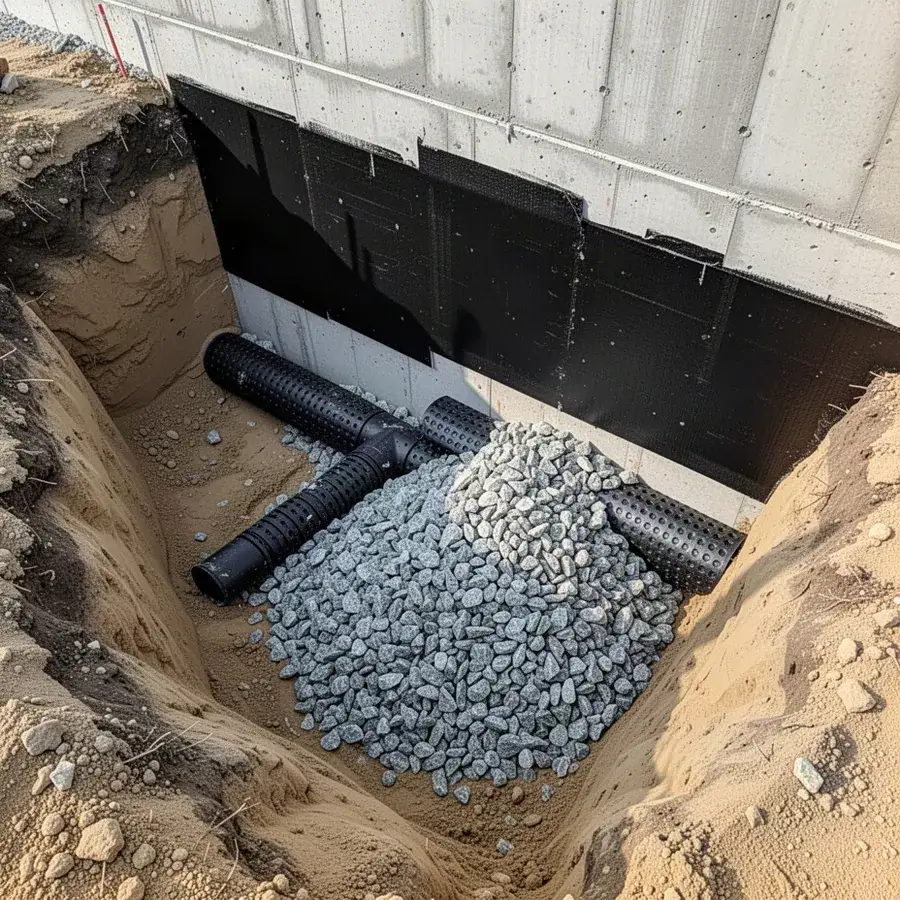
Clear stone, usually 19 mm (3/4 in) washed crushed stone, has no fines, so water passes straight through it. The Ontario Building Code calls for at least 150 mm (6 in) of crushed stone over foundation drainage tile, and we often wrap it in filter fabric to keep silt out.
Clear stone also makes a drainage layer against a wall or around a pool. It is not ideal as general fill under slabs unless it is specified, because it can shift without confinement.
How We Backfill Without Damaging Your Foundation
We backfill a foundation in four steps: check the waterproofing and drainage, confirm the walls are supported, place and compact in lifts, then shape the final grade. A typical house foundation takes one to two days.
- 01
Checking Waterproofing and Weeping Tile
Before any fill goes in, we walk the foundation to confirm the dampproofing or membrane is intact and the weeping tile is laid, connected and covered with stone. A torn dimpled membrane or crushed tile is far cheaper to fix now than after backfill.
On new homes we also confirm the building inspector has signed off where an inspection is required.
- 02
Waiting for Floor Framing or Bracing the Walls
Foundation walls are designed to be held at the top by the floor framing, and the Ontario Building Code wall tables assume that support. Backfilling a tall basement wall before the floor is on can push it inward or crack it at mid-height.
If the schedule cannot wait, the walls must be braced to the engineer's or builder's direction. We will not backfill an unsupported full-height wall just to keep a schedule.
- 03
Placing and Compacting in Lifts
Backfill goes in layers of about 300 mm (12 in), each compacted before the next is placed. Near the wall we use plate compactors or a jumping jack rammer, and larger open areas get a roller or the machine's weight.
We keep heavy excavators and loaded trucks back from fresh walls, because their weight adds sideways pressure. Fill is brought up evenly around the house so one wall is not loaded far more than the opposite one.
- 04
Final Grade Sloping Away From the House
The top of the backfill is shaped to slope away from the foundation, with a little extra height to allow for any remaining settlement. Finished grade should stay at least 150 mm (6 in) below siding or brick.
When the house is complete, our grading and levelling service brings the whole lot to its final elevations and topsoil.
Common Backfill Mistakes That Cause Settlement
Most settlement problems trace back to a handful of shortcuts taken on backfill day. These are the ones we see most often when we are called to fix someone else's work:
- Dumping in one lift: pushing 2.5 m (8 ft) of fill in at once leaves the bottom loose, and it can settle 100 mm or more over the next few years.
- Frozen material: frozen clods compact well on the surface but thaw into voids in spring, so we never backfill with frozen soil or onto frozen ground.
- Debris in the fill: wood offcuts, form ties, concrete chunks and drywall scraps rot or bridge, leaving pockets that collapse later.
- Heavy machines too close: a loaded excavator tracking along a fresh wall can crack it or push it off its footing.
- Saturated clay against the wall: wet clay is hard to compact, drains poorly and expands with frost.
- Skipping the final slope: backfill graded flat ends up sloping toward the house once it settles.
If your yard already has a sunken strip along the house, it can usually be corrected by topping up and regrading. Deeper problems, such as water coming through the wall, may need drainage excavation and new weeping tile.
Backfill Cost and Material Pricing
Backfill cost comes down to volume, material and how much compaction work the job needs. As a general guide, backfilling a typical new home foundation in Waterloo Region with native soil runs roughly $2,500 to $6,000, and switching to imported granular adds material and trucking on top. The firm number comes from a free site visit.
Typical regional material ranges, before delivery, are:
- Native soil: no material cost if it is suitable and already stockpiled on site.
- Granular B or sand: roughly $20 to $35 per tonne.
- 19 mm clear stone: roughly $35 to $55 per tonne.
- Delivery: usually charged per load, with tri-axle dump trucks carrying about 20 to 25 tonnes.
Other cost factors include access around the house, the amount of handwork near windows and decks, hauling away unsuitable native soil, and compaction testing if the engineer or municipality requires it. We serve backfilling in Cambridge and the wider region, so trucking from local pits stays short.
Where We Provide Backfilling
We provide backfilling from our Cambridge yard to homes, farms and businesses within about a 30-minute drive of Cambridge. Choose your community for local permit, soil and neighbourhood details.
Backfilling FAQs
When can you backfill a new foundation?
You can backfill a new foundation once the concrete has gained enough strength, the waterproofing and weeping tile are inspected, and the floor is framed or the walls are braced. On most new homes that means waiting until the main floor deck is on.
What is the best backfill material for a basement?
Free-draining granular such as Granular B or clean sand is the best basement backfill, with clear stone over the weeping tile. Clean, well-drained native soil is fine where it is free of clay lumps, organics and debris.
How long does backfill take to settle?
Loosely placed backfill can keep settling for one to three years, especially through the first few freeze and thaw cycles. Compacting in 300 mm lifts reduces settlement to a small amount, which a final top-up and regrade usually corrects.
Do you supply the backfill material?
Yes. We reuse suitable native soil from your own dig where possible, and we supply and deliver Granular B, sand, clear stone and filter fabric when imported material is the better choice.
Schedule Your Backfill
Tell us when your walls pass inspection and your floor is on, and we will book the backfill around your schedule. You get a clear quote showing the material, the compaction method and the final grade we will leave.
Building from scratch? Our foundation excavation service can dig the hole and close it again, with one crew responsible for both ends of the job.
- Fennex Cambridge Excavation Pros
- 725 Briardean Rd, Cambridge, ON N3H 4R6
- +1 226-894-8631
- info@fennexexcavation.ca
- Mon to Sat 7:00am to 9:30pm
Sun 9:00am to 9:00pm