Cambridge Demolition Contractors
Residential and Commercial Demolition Contractors in Cambridge, ON
Fennex Cambridge Excavation Pros demolishes houses, garages, sheds and commercial buildings across Cambridge, Kitchener, Guelph and Waterloo Region. With more than 40 years of excavation experience, we take a demolition from planning through to a clean, compacted lot.
Our clients are homeowners tearing down to rebuild, builders clearing infill lots, and property owners removing outdated buildings before a sale or a new use. Some jobs are a single rotted shed, and others are a full house with a basement to remove.
Demolition is high-risk work, so credentials matter. We are licensed and insured, registered with WSIB and hold an IHSA Certificate of Recognition (COR) for our health and safety program.
Our Demolition Services
We demolish residential, commercial and accessory buildings, and every quote spells out what is included. A typical scope covers permit support, coordinating utility disconnects, mechanical demolition, foundation removal, sorting and haul-away, and compacted backfill.
House Demolition
House demolition removes the entire structure, including the basement walls and footings unless you plan to reuse them. Most single-family houses come down in one to three working days once permits and disconnects are in place.
We take down bungalows, storey-and-a-half homes and two-storey houses, including the older brick and frame homes common in Galt, Preston and central Kitchener.
Garage and Shed Demolition
Garage and shed demolition is often a half-day to one-day job with a compact excavator or skid steer. Detached garages usually sit on a concrete slab that also has to come out, which our concrete breaking and removal service handles.
Small accessory buildings have simpler permit rules and far lower disposal volumes. We can leave the area graded for sod, a new garage or a patio.
Commercial and Industrial Demolition
Commercial and industrial demolition covers retail buildings, small plazas, warehouses and farm or industrial outbuildings. These jobs need tighter traffic control, heavier equipment and more detailed designated substance surveys.
Demolition can be scheduled to flow straight into servicing and new construction through our commercial excavation services.
Selective and Partial Demolition
Selective demolition removes part of a building while the rest stays standing. Typical jobs include old additions, porches, sunrooms, attached garages and interior gutting before a major renovation.
It takes more care than a full teardown. Expect hand work at the connection point, temporary weather protection, and an engineer's shoring design if a load-bearing wall is affected.
Before Demolition: Permits, Disconnects and Surveys
Before any machine touches a building, three things must be in place: a demolition permit, utility disconnects and a designated substance survey. Skipping any one of them can stop the job or put workers and neighbours at risk.
Demolition Permits
Most buildings need a demolition permit from the municipal building division under the Building Code Act, 1992. Applications typically need a site plan, proof that utilities are disconnected and confirmation that sewer and water services will be capped.
Heritage properties need extra approval. Buildings designated under the Ontario Heritage Act need heritage consent, and owners of listed but not designated properties must give the municipality 60 days' written notice before demolishing.
Gas, Hydro and Water Disconnects
Each utility disconnects its own service before demolition. Enbridge Gas removes the meter and cuts the gas service, and the local electricity distributor, such as Energy+ in Cambridge or Enova Power in Kitchener and Waterloo, removes the hydro service.
The municipality shuts off and caps the water service, and the sanitary and storm laterals are capped at the property line, usually with an inspection. Disconnects can take several weeks to book, so requests should go in early.
Designated Substance and Asbestos Surveys
Ontario's Occupational Health and Safety Act requires the owner to identify designated substances, such as asbestos, lead, mercury and silica, before demolition work is tendered. A qualified consultant inspects the building and prepares a designated substance survey (DSS) report.
Asbestos found in vermiculite insulation, pipe wrap, plaster, floor tile or drywall compound must be removed by a qualified abatement contractor under O. Reg. 278/05 before demolition starts. Houses built before 1990 are the most likely to contain it.
How We Demolish a House
A typical house demolition follows four stages, and most of the machine work takes one to three days. Utility locates through Ontario One Call are requested before we break ground.
- 01
Site Protection and Hoarding
We fence the site with construction fencing or hoarding, protect any trees the municipality wants kept, and set up a stable entrance for trucks. Neighbouring houses on narrow infill lots get extra attention, since their walls can sit within 1.2 m (4 ft) of the property line.
The condition of adjacent driveways, fences and foundations is photographed before work starts. That protects everyone if a question comes up later.
- 02
Mechanical Demolition
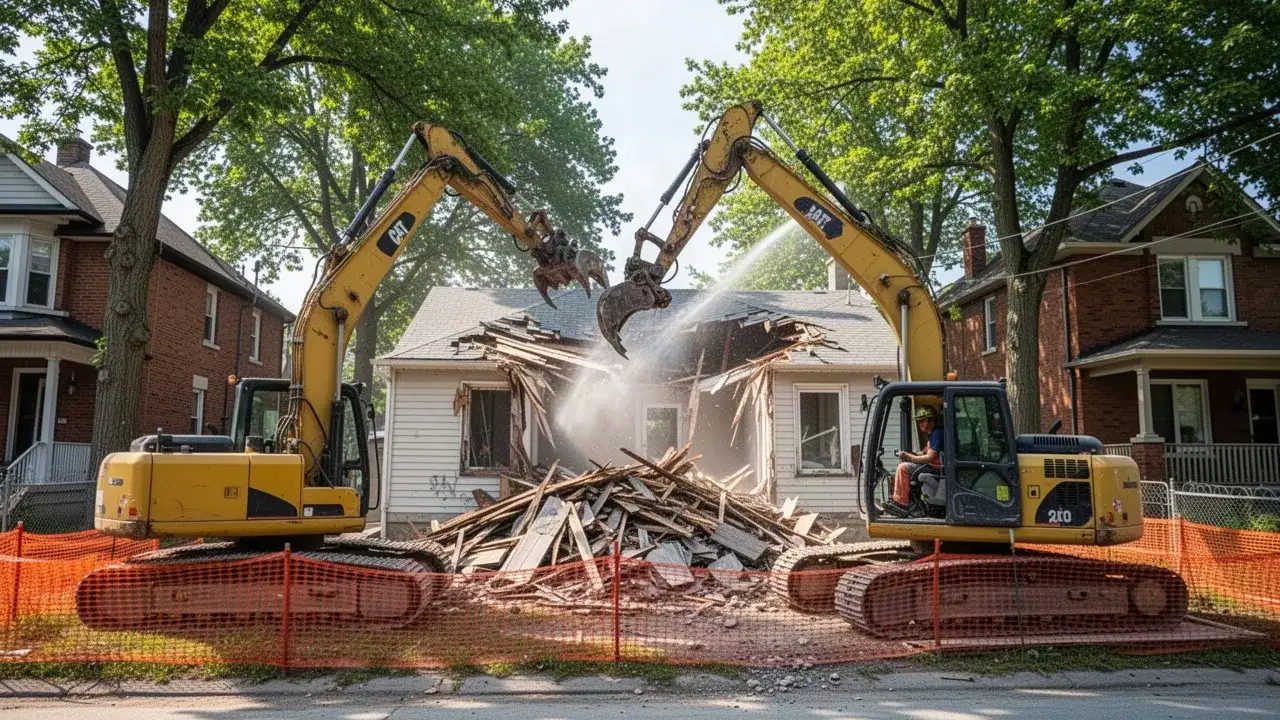
We pull the house down with an excavator fitted with a demolition grapple or thumb, working from the top down and folding the structure inward, away from neighbours. A water spray keeps dust down throughout.
Metals and remaining fixtures are stripped first where practical. The operator sorts material as it comes down, which keeps loads clean for recycling.
- 03
Foundation Removal and Backfill
Once the house is down, we break out the basement walls, floor slab and footings and load them for recycling. If you are rebuilding with a new basement, the hole can be left open and reshaped for the new dig.
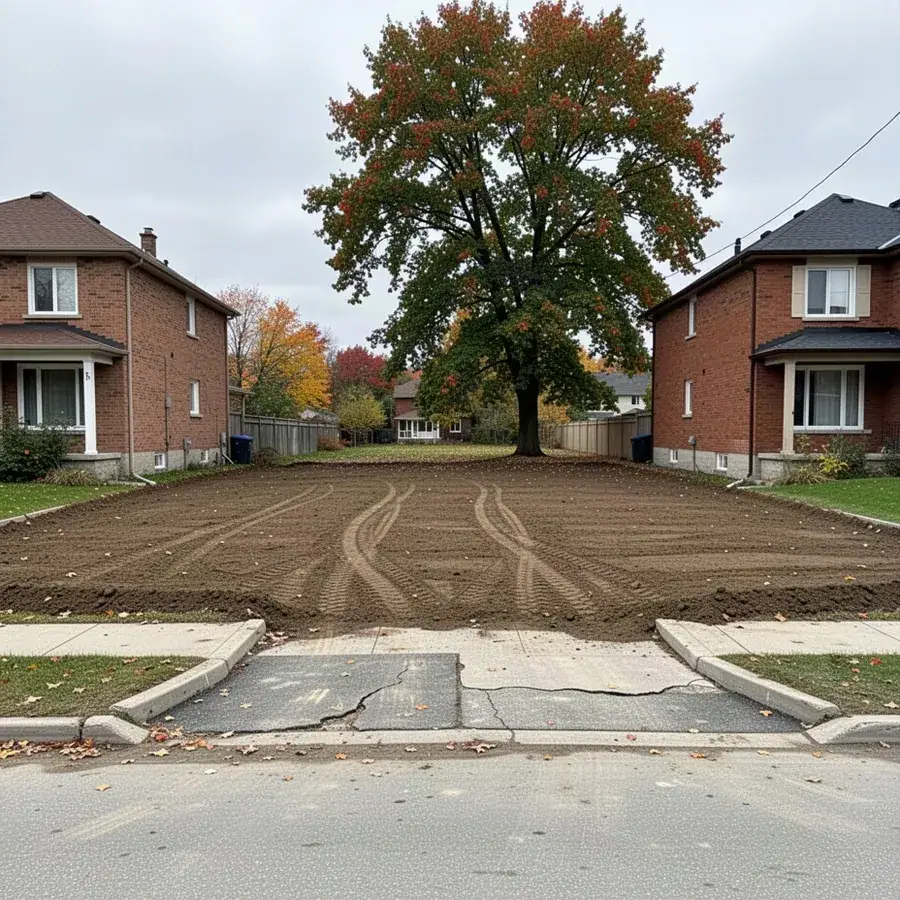
If the lot will stay vacant or get a smaller footprint, we place clean fill or granular material in compacted lifts of about 300 mm (12 in) through our backfilling and compaction service. That prevents the settlement common on lots backfilled in a single dump.
- 04
Sorting, Recycling and Disposal
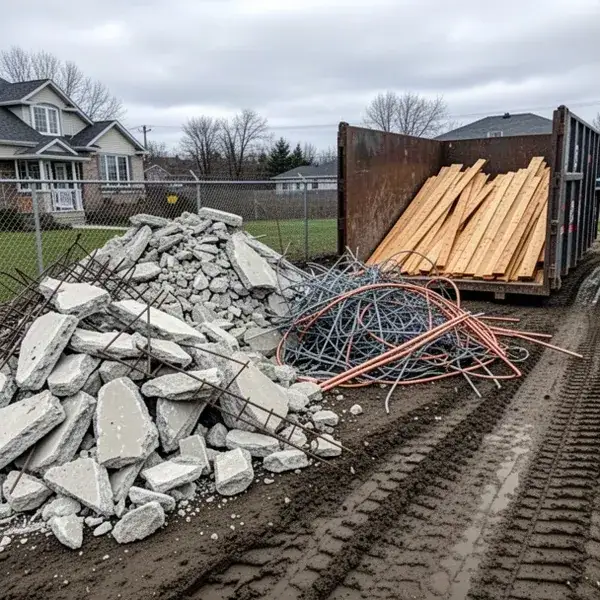
Debris is separated on site into concrete and masonry, metals, clean wood and mixed waste. Each stream goes to the right facility, and only what cannot be recycled goes to landfill.
Any excess soil leaving the site is managed under O. Reg. 406/19, Ontario's excess soil regulation. Depending on volume and site history, it can require testing and tracked delivery to an approved receiving site.
What Gets Recycled From a Demolition
Most of a house, by weight, can be recycled, because concrete, brick and metal make up the bulk of the debris. Clean sorting on site is what makes that possible.
- Concrete and brick: crushed at a recycling yard into recycled aggregate used as granular base and fill.
- Metals: steel beams, ductwork, copper pipe and wiring, and aluminum siding go to scrap metal recyclers.
- Clean wood: untreated framing lumber and sheathing can be chipped for mulch, biomass fuel or composite products.
- Asphalt shingles: accepted by some processors for use in asphalt paving mixes.
- Mixed waste: drywall, insulation, carpet and treated wood usually go to an approved landfill.
Recycling concrete and metal keeps heavy tonnage out of local landfills. It often lowers your disposal cost too, since recycling yards usually charge less than landfill tipping fees for mixed waste.
How Much Does House Demolition Cost?
Most house demolitions in Waterloo Region cost roughly $15,000 to $40,000, including basement removal, disposal and backfill. Small bungalows on open lots sit at the low end, while larger homes, tight infill lots and asbestos abatement push costs higher.
These are general market ranges. Your firm number comes from a free site visit.
Demolition Cost Factors
House demolition cost comes down to how much material there is, how hard it is to reach, and what has to happen before and after.
- Size and construction: floor area, number of storeys, and brick versus frame walls.
- Foundation: a full basement with poured or block walls versus a crawl space or slab.
- Designated substances: asbestos abatement can add several thousand dollars or more.
- Access: narrow lots, overhead hydro wires, shared driveways and protected trees.
- Disposal: total tonnage, how cleanly it sorts, and landfill fees for mixed waste.
- Permits and disconnects: municipal permit fees, utility charges and lateral capping.
- Backfill: volume of imported fill and the compaction required.
Sheds and Garages vs Full Houses
Shed demolition and garage demolition cost far less because there is less material, no basement and usually a simpler permit. A small wood shed often runs $500 to $2,500, while a detached single or double garage with a slab typically falls between $3,000 and $10,000.
Asbestos is less common in sheds, but older garages can still have asbestos-cement siding or roofing. It is worth checking before the quote is finalized.
Teardowns and Rebuilds on Infill Lots
A knock-down rebuild runs best when one contractor handles both the demolition and the new excavation. You avoid two mobilizations, the old basement hole becomes the start of the new dig, and nobody argues about who left what in the ground.
Infill teardowns are common in established neighbourhoods across Cambridge, Kitchener and Waterloo, where older bungalows sit on lots that can carry a larger home. These sites are tight, with neighbours close on both sides, mature street trees and overhead hydro to work around.
Once the old house is out, we can move straight into the foundation excavation for your new home, matching dig depth to your builder's drawings and the approved grading plan. For local conditions, see our page on excavation in Kitchener.
Why Choose Fennex for Demolition
Choose a demolition contractor with verifiable safety credentials, full insurance and the excavation skills to finish the site properly. Fennex has all three.
Safety you can check. We hold an IHSA Certificate of Recognition (COR), are registered with WSIB and carry liability insurance. Ask any demolition company for a current WSIB clearance certificate, which shows its WSIB account is in good standing.
One contractor from teardown to new dig. More than 40 years of excavation means demolition, foundation removal, backfill and any new digging happen with one crew and one schedule.
Clean sorting, honest disposal. Our demolition services separate materials on site, which keeps recycling rates up and disposal costs down.
Where We Provide Demolition
We provide demolition from our Cambridge yard to homes, farms and businesses within about a 30-minute drive of Cambridge. Choose your community for local permit, soil and neighbourhood details.
Demolition FAQs
How much does it cost to demolish a house in Ontario?
Demolishing a typical house in Ontario usually costs between $15,000 and $40,000, and Waterloo Region jobs fall in a similar range. Size, basement construction, asbestos, access and disposal are the main drivers.
Large homes, tight urban lots or major abatement can push the total higher.
How long does a house demolition take?
The demolition itself usually takes one to three working days, plus another day or two for foundation removal and backfill. Planning takes longer, since permits and utility disconnects often need two to six weeks.
Do I need a permit to tear down a shed or garage?
It depends on size. In most Ontario municipalities, accessory buildings of 10 m² (108 sq ft) or less do not need a building permit, while larger sheds and detached garages need a demolition permit.
Any structure with plumbing, gas or electrical service needs those disconnected first. Check with your municipality's building division, or ask us when we quote.
Who disconnects the utilities before demolition?
The utilities themselves disconnect their services, but the owner or contractor books the work. Enbridge Gas removes the gas service, the local hydro distributor removes the electrical service, and the municipality shuts off the water and inspects the capped laterals.
We help coordinate the requests and timing so every disconnect is done before demolition day.
What happens to the basement after demolition?
The basement is either removed and backfilled or left open for a new foundation. For a rebuild, we break out the old walls and footings and reshape the hole to suit the new footprint.
For a vacant lot, we remove the foundation, fill the hole with clean material compacted in lifts, and grade the surface for seed or sod. Old basement walls left buried can cause settlement and headaches for future builders.
Get a Demolition Quote
Tell us what is coming down and what comes next, and we will give you a clear scope and a firm price after a free site visit.
Need driveways, patios or slabs gone too? Our concrete breaking and removal service can handle them on the same mobilization.
- Fennex Cambridge Excavation Pros
- 725 Briardean Rd, Cambridge, ON N3H 4R6
- +1 226-894-8631
- info@fennexexcavation.ca
- Mon to Sat 7:00am to 9:30pm
Sun 9:00am to 9:00pm