Yard and Lot Grading Contractors
Yard Grading and Lot Levelling in Cambridge, Ontario
Fennex Cambridge Excavation Pros grades new building lots and regrades existing yards across Cambridge, Kitchener, Waterloo and the surrounding townships. Our job is simple to describe and exacting to do: make every square metre of your property shed water away from the house and toward a place it can safely go.
Most of our grading calls come from two groups. Homeowners phone after a spring thaw puts water in the basement or a pond in the backyard, and builders need a lot finished to the approved grading plan so the surveyor can sign the final grading certificate.
With more than 40 years of local earthworks, we set slopes with a rotating laser level and grade rod rather than by eye. On a yard where the difference between draining and ponding is 50 mm (2 in), that accuracy is the whole job.
Our Grading and Levelling Services
Our grading and levelling service covers yard regrading for existing homes, lot grading for new construction, and rough and finish grading ready for sod or seed. Every job includes elevation shots, cut and fill to the target slopes and, where needed, screened topsoil to finish.
Land grading is not the same as levelling a yard flat. A properly graded lot is never truly level, because a flat surface holds water.
Yard Grading for Existing Homes
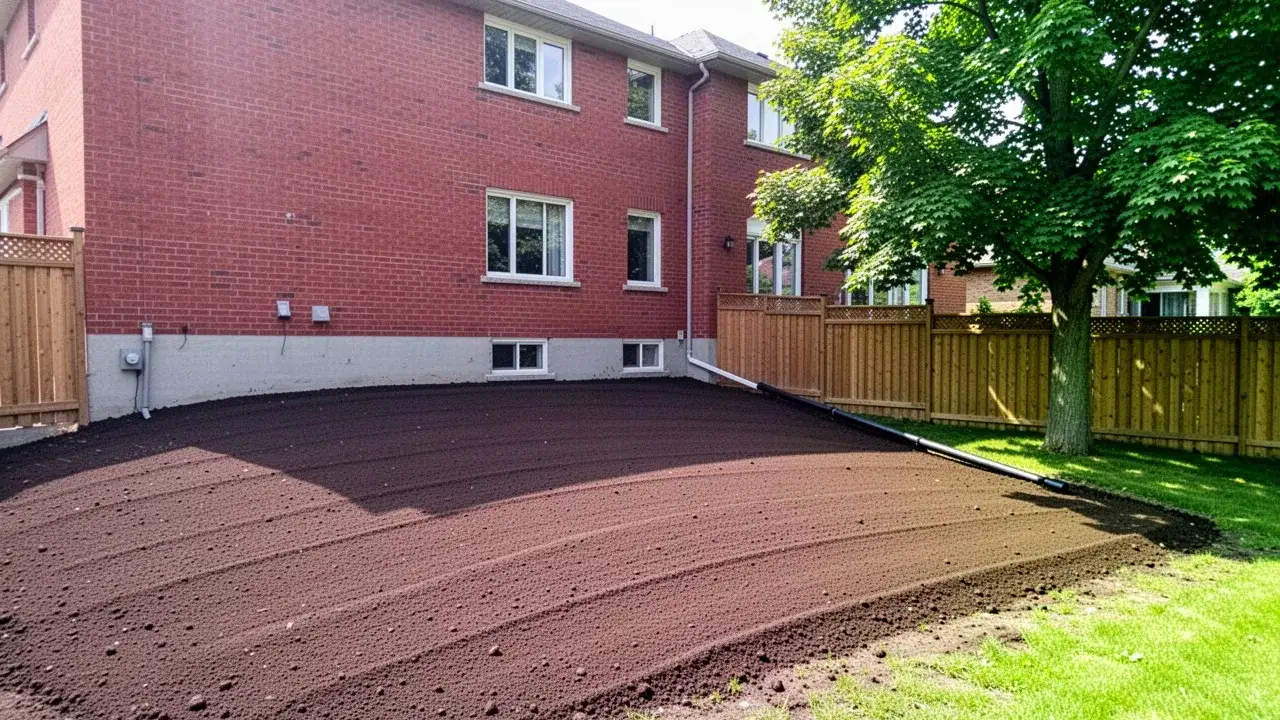
Yard grading for an existing home corrects slopes that send rain and snowmelt toward the foundation. Over time, backfill around a house settles, gardens get built up against the siding and patios sink, until the ground near the wall sits lower than the lawn beyond it.
We rebuild that grade with compactable fill near the foundation, re-cut side yard swales and tie everything into the existing lawn. On older Cambridge and Kitchener homes we also check that the finished grade stays at least 150 mm (6 in) below brick, siding and window wells.
Lot Grading for New Construction
Lot grading for new construction shapes the property to the elevations on the approved grading plan, including finished floor, swales, rear yard catch basins and lot corners. The municipality will not release the builder's grading deposit until those elevations are certified.
We usually return to a new home twice: once for rough grade after foundation backfilling, and again for final grade once the driveway, walks and decks are in.
Rough and Finish Grading for Sod or Seed
Rough grading sets the overall shape of the land to within about 50 mm, and finish grading brings it to the exact elevations with a smooth surface for landscaping. Rough grade is done with native subsoil, and finish grade usually adds 100 to 150 mm (4 to 6 in) of screened topsoil.
A well-finished grade lets sod knit in evenly and leaves no birdbaths for water to collect after the lawn is established.
Signs Your Property Has a Grading Problem
The clearest sign of a grading problem is water that collects where it should not: against the house, in the basement or in the same patch of lawn after every rain. Here is how to read what your yard is telling you.
Water Pooling Against the Foundation
Water pooling beside the foundation is the most common cause of basement leaks we see. When grade slopes toward the house, every downpour soaks the backfill and loads the wall with water pressure.
Check after a heavy rain or during the spring melt. Puddles within 1 to 2 m of the wall, soil washing off garden beds, or ice forming against the foundation in winter all point to negative grade.
Wet Basement After Heavy Rain
A basement that only gets wet after heavy rain is usually a grading or downspout problem, not a failed foundation. Damp patches low on the wall, efflorescence and musty smells that come and go with the weather all fit that pattern.
Water present even in dry spells points instead to a high water table, failed weeping tile or a crack. In that case regrading helps but is not the whole fix, and the wall may need excavation and new drainage.
Soggy Lawn, Ruts and Washouts
A lawn that stays soggy for days, gets rutted by a mower or washes out in channels has low spots or too little slope. Clay soils, common in many Kitchener and Waterloo subdivisions, make this worse because they drain slowly.
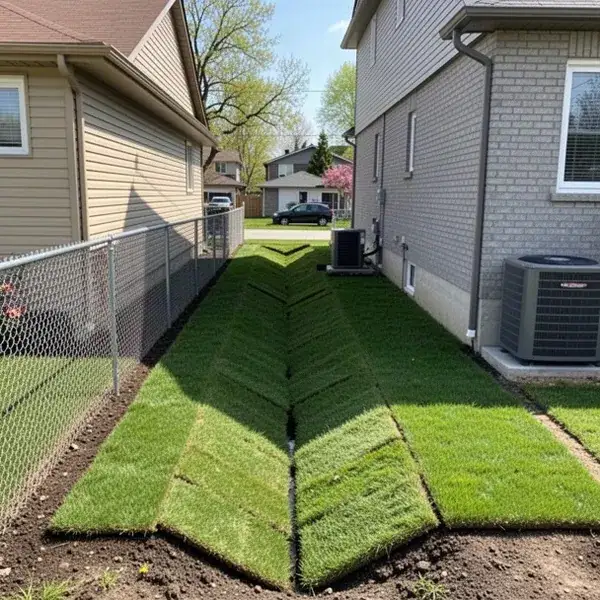
Washouts along a fence line often mean a blocked or flattened swale between two lots. Restoring that swale usually fixes both properties at once.
How Much Slope Your Yard Needs
Your yard should slope away from the house on every side, typically at 2% to 5% for the first few metres from the foundation. A common rule of thumb is about 150 mm (6 in) of fall over the first 3 m (10 ft), which is 5%.
Beyond that zone, lawns can flatten to about 2%, and drainage swales between houses generally need at least 1.5% to 2% to keep water moving. Steeper than about 3:1 (horizontal to vertical) and a slope becomes hard to mow and prone to erosion.
Exact standards vary by municipality and are set out in each city's development or lot grading guidelines. On a new home, the approved grading plan overrides any rule of thumb, and on an existing home we work to the neighbouring elevations so we do not push your water onto the next lot.
Lot Grading Plans and Certificates for New Homes
New homes in Waterloo Region subdivisions are built to an approved lot grading plan, and the lot must be certified to that plan when it is finished. The certificate is signed by an Ontario Land Surveyor or professional engineer who checks the actual elevations against the design.
Builders typically post a lot grading deposit with the municipality or developer, which is held until the final grading certificate is accepted. If the grades are off by more than the allowed tolerance, the deposit stays held until the lot is fixed.
Some properties also need approvals before regrading at all. Land near rivers, creeks or wetlands can be regulated by the Grand River Conservation Authority, where site grading counts as development and needs a GRCA permit, and the City of Guelph requires a permit to alter grade or bring in fill under its Site Alteration By-law.
How We Grade and Level a Property
We grade a property in four steps: survey the existing elevations, cut and fill, laser-check the finish grade, then topsoil and prep for sod or seed. A typical residential backyard regrade takes two to four days.
- 01
Elevation Survey
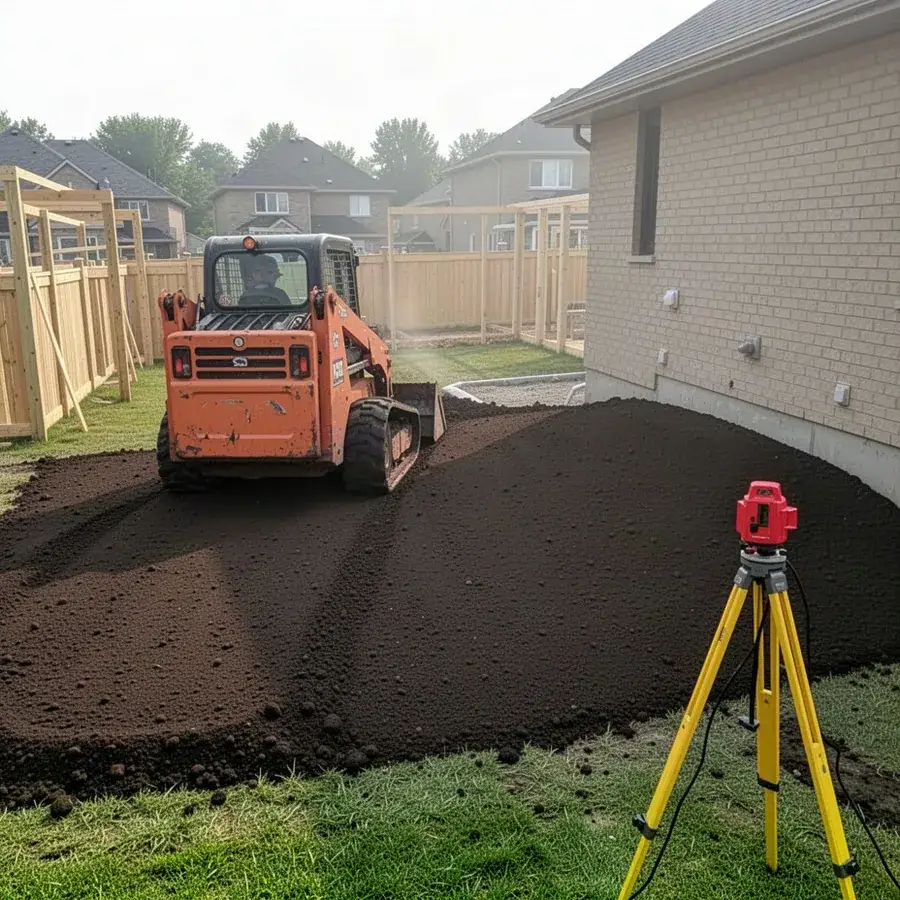
We start by shooting elevations around the house, along the property lines and at any catch basins or swales with a laser level and grade rod. That gives us a map of the high and low spots and tells us how much material needs to move.
We also call Ontario One Call for locates. Gas and cable services are often buried shallow in residential yards, and regrading can cut into them.
- 02
Cutting High Spots and Filling Low Areas
Next we cut down high areas and use that soil to fill low ones, balancing material on site wherever possible. Fill beside the foundation is placed in thin lifts and compacted so it does not settle back into a reverse slope.
Compact track loaders and mini excavators do most residential work because they fit through side yards and leave less damage than wheeled machines.
- 03
Laser-Guided Finish Grading
Finish grading is checked with the laser at regular points so slopes and swales hit the target percentages, not just look right. We trim to within about 25 mm (1 in) of design on lawn areas.
This is where amateur jobs usually fail. A swale that looks fine can hold water over a 10 m run if the fall is only a few centimetres.
- 04
Topsoil and Prep for Sod or Seed
We finish with screened topsoil, usually 100 to 150 mm deep, raked smooth and lightly rolled. The surface is then ready for your landscaper to lay sod or hydroseed.
On slopes steeper than about 3:1 we can install erosion control blanket under seed to hold the soil until roots take.
Yard Grading Cost Factors
Yard grading cost depends mainly on the size of the area, how much fill or topsoil has to come in, and how easy it is to get machines into the yard. Most residential regrades in the region fall roughly between $2,000 and $8,000, with full new-build lot grading and larger properties above that. A free site visit gives you the firm number.
- Area and depth of correction: fixing a strip along one wall costs far less than reshaping a whole backyard.
- Imported fill and topsoil: clean fill, Granular B for compacted zones and screened topsoil are priced by the tonne or cubic metre, plus delivery.
- Access: a narrow side yard, fence, deck or mature tree in the way means smaller machines and more handwork.
- Removal and restoration: old sod, patio stones or garden beds that have to come out, and sod or seed going back in.
- Drainage add-ons: French drains, catch basins, downspout extensions or dry wells to handle water the grade alone cannot move.
If the problem goes beyond surface slope, our drainage excavation service can add buried drainage in the same visit.
Where We Provide Grading and Levelling
We provide grading and levelling from our Cambridge yard to homes, farms and businesses within about a 30-minute drive of Cambridge. Choose your community for local permit, soil and neighbourhood details.
Grading and Levelling FAQs
How much does yard grading cost?
Most residential yard grading in Waterloo Region costs roughly $2,000 to $8,000, depending on the size of the area, imported fill and topsoil, access and any drainage add-ons. We confirm the price after a free on-site assessment.
What slope should my yard have away from the house?
Your yard should fall away from the house at about 2% to 5% for the first few metres, or roughly 150 mm (6 in) over 3 m (10 ft), then at least 1.5% to 2% across lawns and swales.
Do I need a lot grading certificate?
You need a lot grading certificate for most new homes in Waterloo Region subdivisions, and some municipalities also ask for grading approval with additions, large accessory buildings or pools. Regrading an existing yard usually does not need one unless it changes drainage onto neighbouring lots.
When is the best time to regrade a yard?
The best time to regrade is from late spring through early fall, when soil is dry enough to compact and sod or seed will establish. Saturated spring clay and frozen ground both give poor results.
Book a Grading Assessment
Tell us where the water goes and we will come out, shoot the elevations and show you exactly what slope your yard has now and what it needs. You get a written quote with the fill, topsoil and restoration spelled out.
We cover yard grading in Waterloo, Cambridge, Kitchener and nearby townships, with office hours seven days a week.
- Fennex Cambridge Excavation Pros
- 725 Briardean Rd, Cambridge, ON N3H 4R6
- +1 226-894-8631
- info@fennexexcavation.ca
- Mon to Sat 7:00am to 9:30pm
Sun 9:00am to 9:00pm