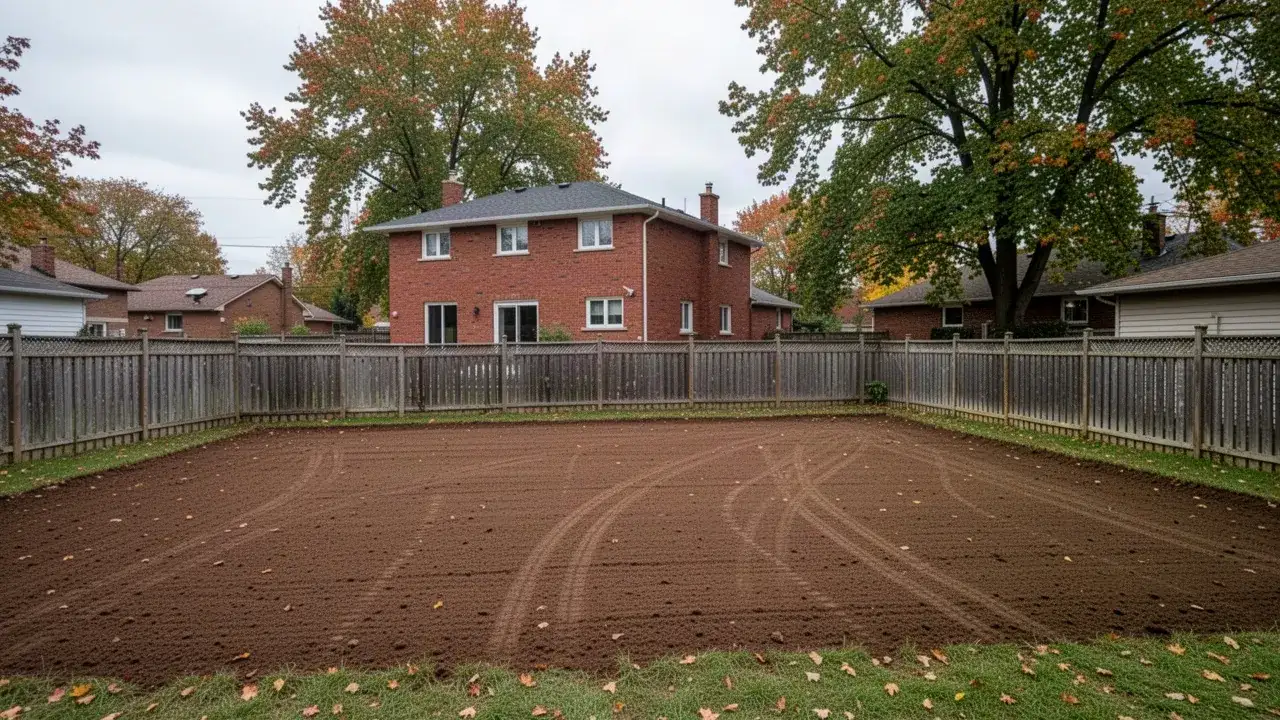
Inground Pool Removal Contractors
Inground Swimming Pool Removal in Cambridge, Ontario
Fennex Cambridge Excavation Pros removes inground and above-ground swimming pools across Cambridge and Waterloo Region, then backfills and grades the space so it is ready for lawn, a garden or a future addition. We have been digging, demolishing and backfilling in this area for more than 40 years. We are licensed, insured, WSIB covered and hold an IHSA Certificate of Recognition (COR).
Most homeowners call us when a pool needs a new liner, a cracked shell or a failing heater and the repair quote rivals the cost of taking it out. Others want lower insurance premiums, an easier sale or simply their backyard back. Whatever the reason, the job comes down to the same thing: getting the old structure out and putting back fill that will not settle.
That last part is where pool removals go wrong. A hole 1.8 to 2.7 m (6 to 9 ft) deep filled with loose dirt will sink for years, so we place fill in thin, compacted lifts and can arrange density testing when you plan to build on the area later.
Our Swimming Pool Removal Services
We handle inground pool removal from start to finish: the pool itself, the surrounding deck or patio, the equipment pad and the final grade. Each pool type comes apart differently, so the method, machine and disposal route change with the construction.
Above-ground pools are the simplest case and usually come out in a day, including the frame, liner and any sand or stone base. For inground pools the scope typically includes the items below.
- Removal of the shell, walls or panels, plus steel, rebar and liner material
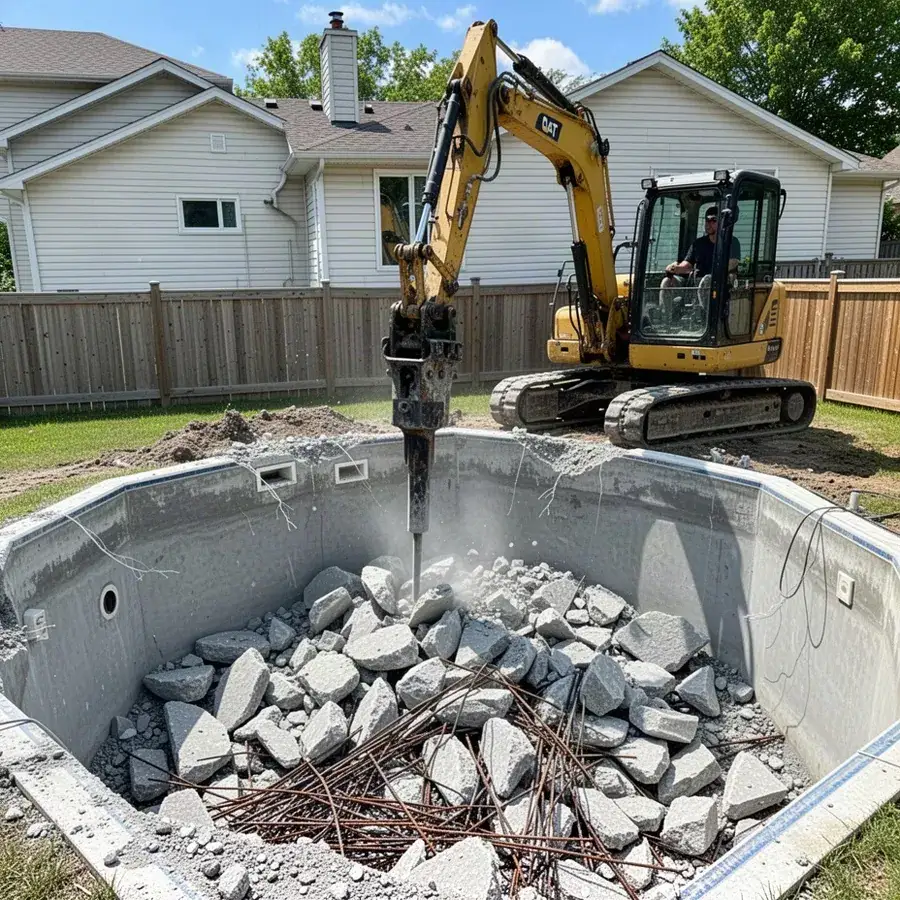
- Breaking out concrete decks, coping and interlock with a hydraulic breaker
- Capping return lines, skimmer lines and the main drain after the electrician and gas fitter disconnect equipment
- Hauling concrete to an aggregate recycler and steel to a scrap yard
- Clean granular or approved fill placed in compacted lifts
- Topsoil, fine grading and a surface ready for sod or seed
Concrete-heavy jobs overlap with our concrete breaking and removal service, which is often booked alongside a pool removal when a large patio or walkway is coming out too.
Vinyl Liner Pool Removal
Vinyl liner pools are usually the fastest inground pools to remove because the walls are steel or polymer panels bolted to a frame. We cut and pull the liner, unbolt or shear the wall panels and braces, and lift out the concrete or vermiculite floor base.
Steel panels go to a scrap metal recycler, which keeps landfill fees down. Most vinyl removals in a typical suburban yard take 2 to 3 days from first dig to final grade.
Concrete and Gunite Pool Removal
Poured concrete and gunite (sprayed concrete) pools have reinforced walls 150 to 250 mm (6 to 10 in) thick, so they take the most work. We break the shell with an excavator-mounted hydraulic breaker, separate the rebar and load the rubble for recycling.
On full removals every piece of concrete leaves the site. Expect 3 to 5 working days, longer if access is tight and material has to come out through a narrow side yard.
Fibreglass Pool Removal
A fibreglass pool is a single moulded shell, so it is either cut into sections or, on open lots, lifted out whole. We cut it with a demolition saw, remove the gravel or sand bedding it sits on and check the hole for groundwater before filling.
Fibreglass does not recycle like concrete or steel, so it is disposed of as construction waste. Plan on 2 to 3 days for most fibreglass removals.
Full Removal vs Partial Fill-In
Full removal takes the whole pool out and leaves ground you can build on, while a partial fill-in leaves the lower shell buried and costs less. The right choice depends on what you want to do with the yard in the next 10 to 20 years and how soon you might sell.
We quote both options on the same visit so you can see the price gap for your specific pool rather than a rule of thumb.
Full Pool Removal
With full removal, the floor, walls, deck and all buried pipe come out and the hole is backfilled with clean material compacted in lifts. The result behaves like native ground, so a garage, addition, shed slab or in-ground garden can go there later.
It costs more because there is more breaking, more trucking and more imported fill. It is the option we recommend whenever building over the area is a real possibility.
Partial Removal and Fill-In
In a partial removal, we break off the top 450 to 900 mm (18 to 36 in) of the walls, punch drainage holes through the floor and fill the remaining basin. The holes stop the old shell from holding water like a bathtub, which would otherwise create a soggy spot and frost movement.
It typically costs noticeably less than full removal. The trade-off is that the area is generally suitable only for lawn or landscaping, not structures.
Which Option Is Better for Resale
Full removal is the stronger choice for resale because there is nothing left in the ground to explain. A buried shell is a known material fact, and buyers, home inspectors and their lawyers increasingly ask whether a former pool was removed or filled in.
If you choose partial removal, keep the contract, photos and a sketch showing where the shell sits. Ask your real estate lawyer how to disclose it when you sell.
How We Remove an Inground Pool
A typical inground pool removal follows four stages and takes 2 to 5 working days on site. Locates through Ontario One Call are requested before any digging, since gas lines to pool heaters and buried electrical feeds often run through the work area.
- 01
Draining and Disconnecting Equipment
The pool is drained first, and chlorine should be left to drop to near zero before the water goes anywhere. Discharge onto your own lawn so it soaks in rather than running onto a neighbour's property or into a storm drain, and check your municipality's rules on pool water discharge.
Electrical feeds to the pump, heater and lights must be disconnected by a Licensed Electrical Contractor, and gas heaters by a TSSA-registered gas fitter. We do not touch live services, and we schedule the dig once both are safely capped.
- 02
Breaking Out the Shell and Deck
We bring in an excavator sized for your access, fitted with a hydraulic breaker for concrete and a bucket with a thumb for sorting debris. Where the only access is a side yard, a compact excavator and tracked skid steer can work through a gap of about 1.5 m (5 ft).
Concrete, steel and other waste are separated as they come out so each goes to the right recycler or disposal site. We protect lawns and driveways along the haul route with plywood or ground mats where needed.
- 03
Backfilling in Compacted Lifts
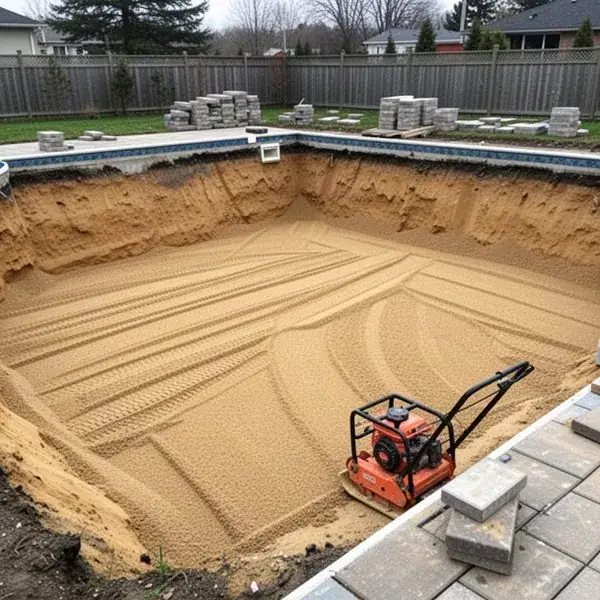
Fill goes back in lifts of about 200 to 300 mm (8 to 12 in), each compacted before the next one is placed. We typically use Granular B or clean, well-graded sand and gravel for full removals, because it compacts reliably and drains well in the clay soils common across Waterloo Region.
Compaction is done with a vibratory roller or a heavy plate tamper depending on the space. This is the same lift-by-lift method used on our backfilling service around new foundations.
- 04
Topsoil and Final Grade
The final 100 to 150 mm (4 to 6 in) is screened topsoil, graded so water flows away from the house at a positive slope. We tie the new grade into the surrounding lawn and fences so there is no hump or dip where the pool used to be.
The area is then ready for sod, seed or a garden bed. Sod can usually go down the same week.
Compaction Testing and Paperwork for Future Buyers
If you might ever build on the former pool area, ask for compaction testing and keep the results with your house documents. An independent geotechnical technician tests each lift with a nuclear density gauge and reports the result as a percentage of Standard Proctor Maximum Dry Density (SPMDD), with 95 percent a common target for structural fill.
A compaction report gives a future builder, building inspector or buyer proof that the fill was placed properly. Without it, an engineer may require test pits or deeper footings before approving a structure on that spot.
At the end of every removal we provide a written summary of what was removed, what fill was used and where any remaining shell sits. Together with photos taken during the work, this is the paperwork that answers a buyer's question in one email instead of a renegotiation.
How Much Does Pool Removal Cost?
Pool removal cost depends mainly on pool type, size, access and whether you choose full or partial removal. As a general guide for Southern Ontario, partial fill-ins often fall between $5,000 and $12,000, and full removals between $10,000 and $25,000 or more for large concrete pools with decks.
The firm number comes from a free site visit, where we measure the pool, check access and look at what surrounds it.
- Pool type: vinyl is usually least expensive, concrete and gunite the most
- Size and depth: more volume means more breaking, trucking and fill
- Removal method: full removal needs more fill and more disposal than a partial fill-in
- Access: narrow side yards, fences and retaining walls slow the work and may need smaller machines
- Decks and extras: concrete or interlock decks, diving boards, slides and equipment pads add time
- Fill and testing: imported Granular B, topsoil and optional compaction testing
- Restoration: fence repairs, sod and any driveway protection along the haul route
Permits and Notices for Pool Removal
Whether you need a permit to remove a pool depends on your municipality and your lot. Many Ontario municipalities do not require a building permit to remove a residential pool, but some do, and changes to lot grading, fill volumes or work in a Grand River Conservation Authority (GRCA) regulated area can trigger separate approvals.
We check the rules for your address before quoting. Where a permit or site alteration approval is needed, we tell you exactly which office issues it and what drawings or information they will ask for.
Once the pool is gone, the pool enclosure by-law that required your fence and self-closing gate no longer applies to that yard. It is worth telling your home insurer, since removing the pool can change your liability coverage and premium.
Where We Provide Swimming Pool Removal
We provide swimming pool removal from our Cambridge yard to homes, farms and businesses within about a 30-minute drive of Cambridge. Choose your community for local permit, soil and neighbourhood details.
Pool Removal FAQs
How much does it cost to remove an inground pool in Ontario?
Most inground pool removals in Ontario cost roughly $5,000 to $12,000 for a partial fill-in and $10,000 to $25,000 or more for full removal. Pool type, access and fill are the biggest drivers, as explained in our cost section above.
We give a fixed written quote after a free site visit.
How long does inground pool removal take?
Most inground pool removals take 2 to 5 working days once draining and disconnects are done. Vinyl and fibreglass pools are at the shorter end, while large concrete pools with decks and tight access take the longest.
Draining usually happens in the days before we arrive.
Can I build on the area after a pool is removed?
Yes, you can build on the area after a full removal with properly compacted fill. Ask for compaction testing during backfill so you have a report to give the building department and your designer.
After a partial fill-in, building over the old shell is not recommended.
Do I need a permit to remove a pool?
It depends on your municipality and lot. Some cities require a permit or notice for pool removal, and grading changes or work in a GRCA regulated area can need separate approval.
We confirm the requirements for your address before work starts.
Reclaim Your Backyard
An old pool does not have to keep costing you in repairs, chemicals and insurance. We will look at your pool, price full removal and fill-in side by side, and leave the yard graded and ready for whatever comes next.
Planning a new lawn or patio afterward? Our grading and levelling service sets the finished slopes, and we work throughout Cambridge, Kitchener and Waterloo.
- Fennex Cambridge Excavation Pros
- 725 Briardean Rd, Cambridge, ON N3H 4R6
- +1 226-894-8631
- info@fennexexcavation.ca
- Mon to Sat 7:00am to 9:30pm
Sun 9:00am to 9:00pm