Sewer and Water Service Contractors
Sewer Line Replacement and Water Service Excavation in Cambridge, ON
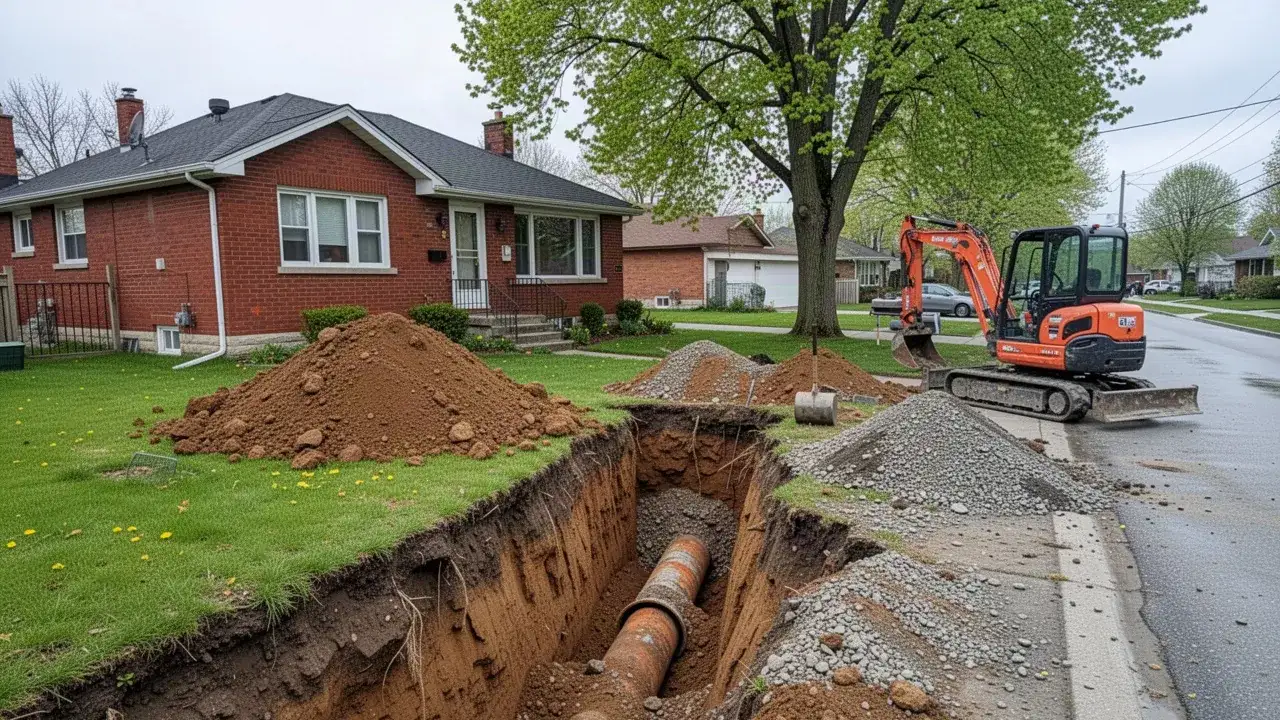
Fennex Cambridge Excavation Pros excavates and replaces sewer laterals, water services and storm lines from the house to the property line or the municipal main. We dig it, lay new pipe to the right grade and depth, get it inspected, and restore your lawn or driveway. Our crews have done this kind of work around Cambridge for more than 40 years.
Most of our calls come from homeowners after a basement backup, buyers whose home inspector ran a camera down the drain and found a cracked clay lateral, and owners of older homes replacing a lead or galvanized water service. Builders and commercial property managers call us for new service connections, storm laterals and catch basins.
Municipal connections come with rules: permits, road occupancy approvals, inspections before backfill and restoration standards. We plan for all of them before the first bucket of soil comes out, so the job is not stalled halfway with an open hole in your front yard.
Our Sewer, Water and Storm Line Services
We handle the full excavation side of service line work: digging, removing the old pipe, laying new pipe on proper bedding, making connections and restoring the surface. Each line type has its own requirements, so the approach changes with the pipe.
For new electrical, gas or private water runs that do not connect to the street, our utility trenching service is the better fit.
Sewer Lateral Replacement
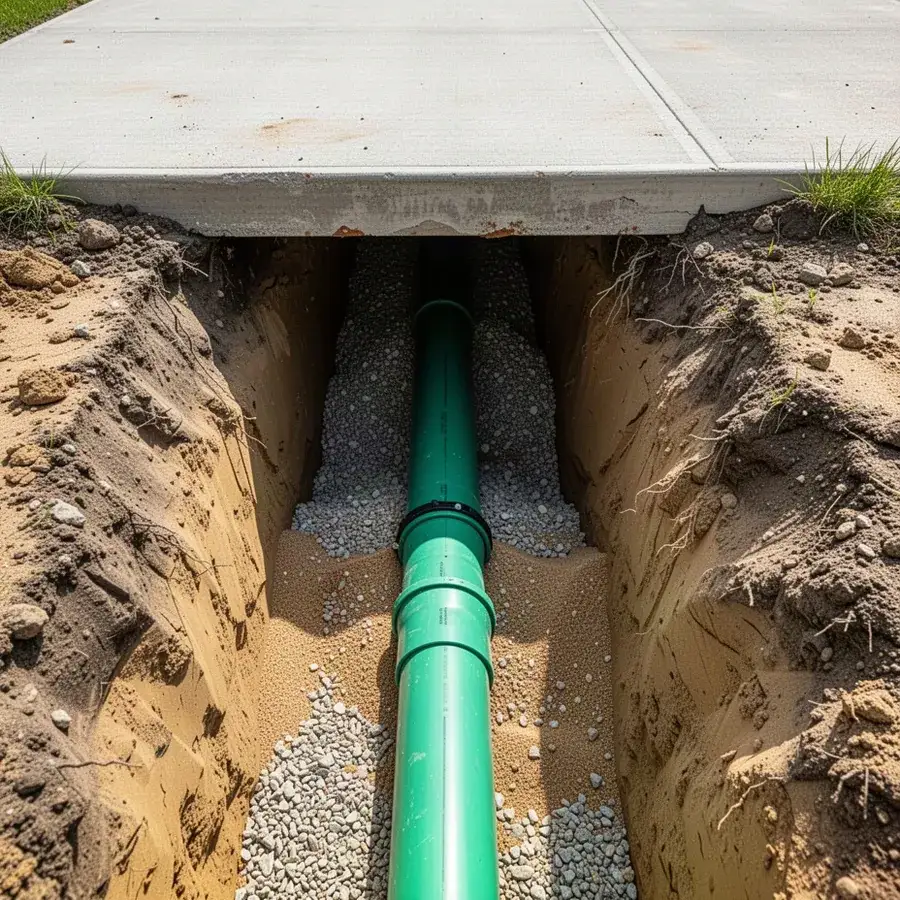
A sewer lateral is the pipe that carries wastewater from your house to the municipal sewer main under the street. Sewer line replacement means digging out the failed lateral and installing new PVC pipe at a continuous, even slope.
We replace the private section from the foundation wall to the property line, and the full length to the main when the municipality permits or requires it. Where needed we add a cleanout and a backwater valve while the line is open.
Water Service Line Replacement
Water line replacement swaps the pipe between the curb stop (the shut-off valve near the property line) and the water meter inside your house. Homes built before the mid-1950s may still have a lead service, and many homes from the 1950s and 1960s have galvanized steel that has rusted shut from the inside.
We excavate the route, install new copper or plastic service pipe below frost depth, and coordinate the municipal shut-off and reconnection.
Storm Sewer and Catch Basin Connections
Storm lines carry rainwater, not sewage. We install storm laterals, rear-yard and parking lot catch basins, and the piping that connects them to a municipal storm sewer or an approved outlet.
For commercial lots this includes precast concrete catch basins with frame and grate set to the paving grade. Surface water problems that do not need a storm connection are usually solved with our drainage excavation service instead.
Signs Your Sewer or Water Line Needs Replacing
Repeated backups, low water pressure and unexplained wet spots in the yard are the three warning signs we see most. Any one of them is worth a camera inspection before it turns into a flooded basement or a sinkhole.
Slow Drains, Gurgling and Sewer Backups
When every fixture in the house drains slowly, or the floor drain gurgles when the washing machine empties, the problem is usually in the lateral rather than a single drain. Tree roots work into clay tile joints, cracked pipe lets soil in, and a sagging section called a belly holds water and solids.
Snaking or flushing buys time, but a collapsed or badly bellied line will keep backing up until it is dug and replaced.
Low Water Pressure or Discoloured Water
Weak pressure at every tap, especially when two fixtures run at once, points to an undersized or corroded service line. Galvanized steel narrows as it rusts from the inside, and brown water after the taps sit overnight is a common sign.
Older 19 mm (3/4 in) services also struggle to supply modern households, so many owners upsize to 25 mm (1 in) when they replace.
Wet Spots or Sinkholes in the Yard
A patch of lawn that stays soft and green in a dry spell, or a depression forming over the line, means water is leaving the pipe. A leaking water service can wash out fine soil for months before the ground drops.
Leaking sewers do the same thing and can also contaminate the soil, so we treat a sinking strip of lawn between the house and the street as urgent.
Pipe Materials We Install and Replace
Old laterals in our area are usually clay tile or cast iron, and new ones are PVC. Water services are moving from lead and galvanized steel to Type K copper or approved plastic pipe, depending on what the municipality accepts.
PVC Sewer Pipe
PVC sewer pipe is the modern standard for laterals, typically 100 to 150 mm (4 to 6 in) in diameter and rated SDR 28 or SDR 35. Gasketed bell joints stay sealed against roots, and the smooth interior keeps solids moving.
We lay it on compacted granular bedding at a consistent fall, commonly around 2 percent for a residential lateral, then haunch and cover it before backfill so the pipe cannot shift or flatten.
Copper and PEX Water Service
Type K soft copper is the long-standing choice for water services and is still required by some municipalities on the city side of the curb stop. It is durable and can be thawed electrically, but it costs more and is attacked by some aggressive soils.
PEX and polyethylene water service pipe, certified to CSA B137 standards, are flexible, freeze resistant and cheaper per metre. Where they are permitted on the private side, they are often the practical choice for long or curved runs.
Replacing Clay Tile and Cast Iron Laterals
Clay tile laterals are common in homes built before the 1970s in older parts of Cambridge, Kitchener and Waterloo. The short sections and mortar or early rubber joints let roots in, and the pipe cracks when the ground settles.
Cast iron laterals scale and rust from the inside until the bottom of the pipe wears through. Both are replaced with continuous PVC, and we use approved transition couplings wherever new pipe meets old.
Who Owns the Line: Your Side vs the Municipality's
In most Waterloo Region and Wellington County municipalities, you own the sewer lateral and water service from your house to the property line or curb stop, and the municipality owns the rest. That means the cost of repairing your side is yours, while problems on the city side are usually the municipality's to fix.
When a camera inspection shows the damage is past the property line, we document it and you contact the city before any digging. Sometimes the municipality repairs its section and we replace yours in the same window, which saves a second excavation.
Work in the boulevard or road needs municipal approval even when the pipe is technically yours to replace. We confirm each municipality's current policy for your street before we quote.
Our Line Replacement Process
Most private-side replacements take 1 to 3 days on site once permits are in hand. Jobs that cross the road take longer because of traffic control and municipal inspections.
- 01
Camera Inspection and Locates
A sewer camera inspection confirms where the line has failed, how deep it is and whether a spot repair or full replacement makes sense. We review the footage with you before recommending anything.
We then request Ontario One Call locates so gas, hydro and telecom lines in the front yard are marked before excavation.
- 02
Permits and Road Occupancy Approvals
Replacing a building sewer or water service needs a plumbing permit from the local building department, with an inspection before the trench is backfilled. Digging in the boulevard, sidewalk or road also needs a road occupancy or road cut permit from the municipality.
Those approvals set traffic control, restoration standards and sometimes the hours we can work, so we build them into the schedule and the quote.
- 03
Excavation, Pipe Laying and Connection
Sewer laterals are all about grade, so we laser or string the line and check the fall as each length goes in. Water services are all about depth, so we keep them below frost for their full length, typically around 1.5 to 1.8 m (5 to 6 ft) of cover.
Where the trench is deeper than 1.2 m (4 ft) we slope the walls or use a trench box, as Ontario Regulation 213/91 requires.
- 04
Inspection, Backfill and Restoration
The inspector sees the new pipe, bedding and connections before cover. We then backfill in compacted lifts, with Granular A under driveways and sidewalks so the surface does not settle.
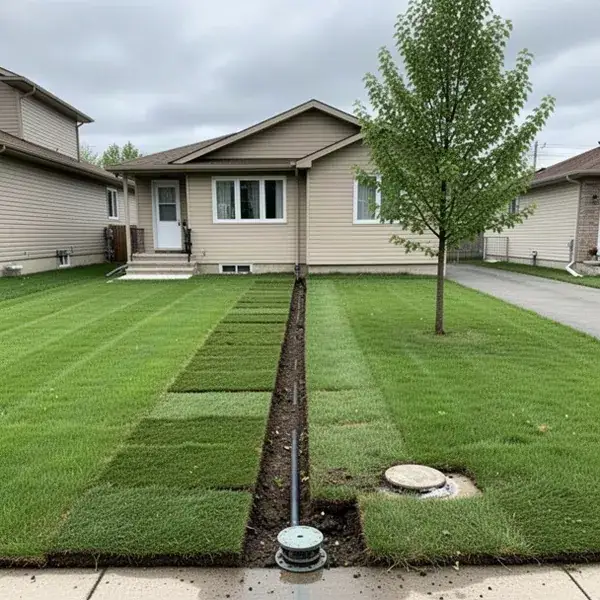
Finish work matches what was there: topsoil and sod on lawns, and asphalt or concrete patching on hard surfaces as the permit requires.
Open-Cut Excavation vs Trenchless Repair
Open-cut excavation is the right choice when the pipe has collapsed, has a belly, was laid at the wrong grade, or needs new connections, cleanouts or a backwater valve. Trenchless methods such as cured-in-place pipe (CIPP) lining and pipe bursting work well when the old pipe is still roughly round and on grade.
Lining puts a resin tube inside the old pipe, so it keeps the same slope and any sags stay. Pipe bursting pulls a new pipe through the path of the old one, but it still needs pits at each end and is limited by nearby utilities and rock.
We are an excavation contractor and we will be straight with you about which method suits your line. If trenchless is the better answer, we will say so; if the line needs to be rebuilt to grade, digging is the way to do it once and do it properly.
Sewer and Water Line Replacement Cost
Most private-side sewer lateral or water service replacements in Waterloo Region fall roughly between $5,000 and $15,000. Jobs that run under the road to the main, or replace both lines at once, can reach $15,000 to $30,000 or more.
The biggest cost drivers are:
- Length and depth: a deep lateral to a main on the far side of the street is a much bigger dig than a short private run.
- Surface restoration: lawn is the least expensive; interlock, concrete driveways and asphalt road cuts add cost.
- Road work: traffic control, road occupancy fees and municipal restoration standards.
- Permits and inspections: plumbing permits and any municipal connection fees.
- Obstacles: mature trees, porches, other utilities, rock or a high water table that needs pumping.
- Add-ons: a backwater valve, cleanouts or upsizing the water service.
If the job needs a driveway rebuilt afterwards, our driveway excavation and preparation crew can prepare a new compacted base in the same visit. Every quote is fixed and written after a free site visit.
Where We Provide Sewer, Water and Storm Line Excavation
We provide sewer, water and storm line excavation from our Cambridge yard to homes, farms and businesses within about a 30-minute drive of Cambridge. Choose your community for local permit, soil and neighbourhood details.
Sewer and Water Line FAQs
How much does sewer line replacement cost in Ontario?
A typical private-side sewer lateral replacement in Ontario costs roughly $5,000 to $15,000. Depth, length, surface restoration and whether the work crosses the road are what move the price.
We give a fixed written price after looking at the camera footage and the site.
How deep are water lines buried in Waterloo Region?
Water services in Waterloo Region are generally buried with about 1.5 to 1.8 m (5 to 6 ft) of cover to keep them below the frost line. The exact requirement comes from the municipality's standards for your street.
Where that depth is not possible, the line may need rigid foam insulation over it.
Is the city responsible for my sewer line?
Usually only from the property line to the main. The section between your house and the property line is normally the owner's responsibility to maintain and replace.
If a camera inspection shows the failure is on the city side, contact your municipality first so they can assess it.
Should I install a backwater valve while the line is open?
Often, yes. A backwater valve closes when the municipal sewer surcharges, stopping sewage from flowing back into your basement, and adding one is far cheaper with the lateral already exposed.
It needs a plumbing permit and must stay accessible for cleaning. Some municipalities offer basement flooding subsidies, so check with yours before the work starts.
Book Your Line Replacement
Send us your camera inspection report or tell us what you are seeing, and we will come out, look at the route and give you a written price. We work in Kitchener, Cambridge, Waterloo and Guelph, and our hours run into the evening seven days a week.
Need power or gas run to a garage while the yard is already open? Our utility trenching service can be planned into the same job.
- Fennex Cambridge Excavation Pros
- 725 Briardean Rd, Cambridge, ON N3H 4R6
- +1 226-894-8631
- info@fennexexcavation.ca
- Mon to Sat 7:00am to 9:30pm
Sun 9:00am to 9:00pm