Private and Development Road Builders
Road Construction Services in Cambridge and Waterloo Region
Fennex Cambridge Excavation Pros builds roads from the subgrade up, from stripped native soil to a finished, compacted granular base ready for traffic or asphalt. For more than 40 years we have handled the earthworks, drainage and granular layers that decide whether a road lasts five years or thirty.
Our road construction clients include developers building subdivision streets, rural landowners who need a private road or farm lane, and commercial and institutional sites that need internal roads and service lanes. We work across Cambridge, Kitchener, Waterloo, Guelph and the surrounding townships.
We build to the Ontario Provincial Standard Specifications (OPSS) that engineers and municipalities write into their drawings, including OPSS 1010 for aggregates and OPSS 501 for compaction. We are licensed, insured, WSIB covered and COR certified through IHSA, which matters to developers and owners whose contracts require it.
Our Road Construction Services
We build four main kinds of roads, each with its own traffic loads, approval path and standard. The structure underneath is similar, but the thickness, drainage and paperwork change with how the road will be used and who will own it.
Private Roads and Laneways
Private roads serve several rural homes off one entrance, a condominium development or an estate lot set well back from the road. They are owned and maintained by the landowners or condo corporation, so a durable base keeps long-term grading and pothole costs down.
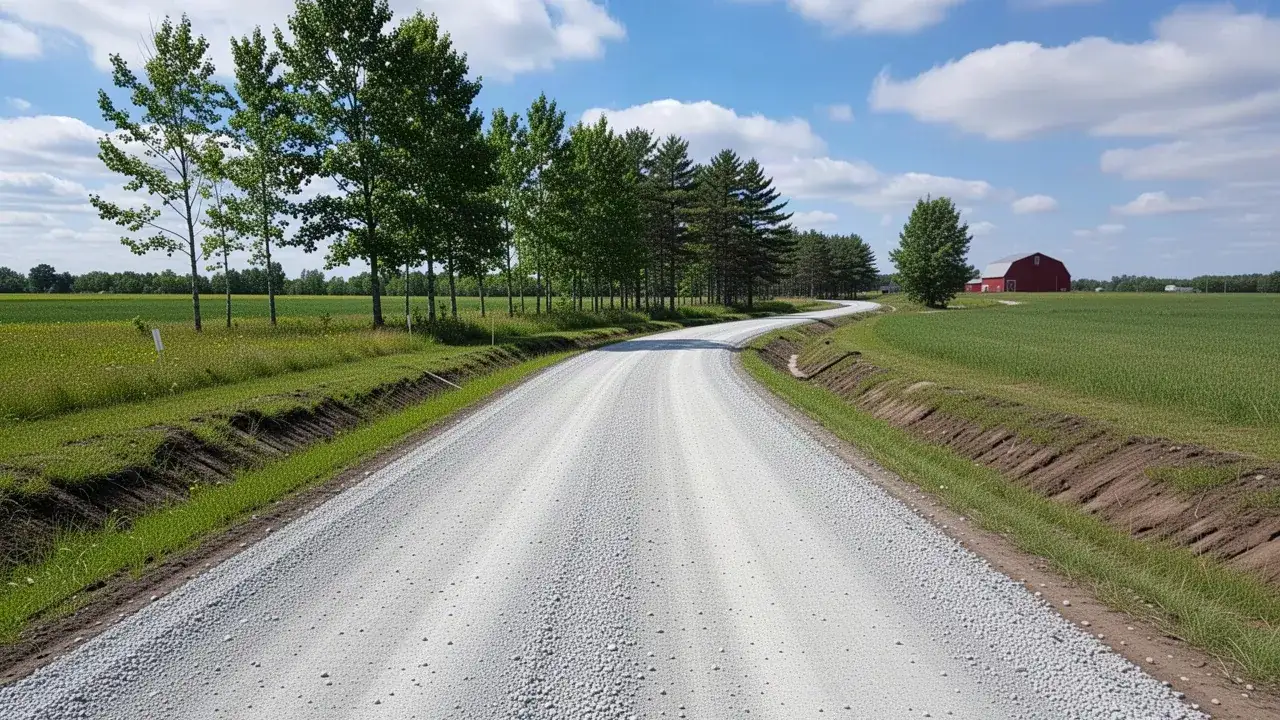
We build them in gravel or prepared for paving, with ditches or swales on both sides and a crown that sheds water.
Subdivision and Development Roads
Subdivision roads are built to the municipality's engineering standards under a subdivision agreement, then inspected before the city or township assumes them. The consulting engineer's drawings set the grades, granular depths and compaction testing schedule.
We typically build the base in stages: granular in place for construction traffic, then final lifts and grade adjustments before the top course of asphalt goes down near the end of the build-out.
Farm Lanes and Access Roads
Farm lanes have to carry loaded grain trucks, manure spreaders and combines, often in spring when the ground is soft. That calls for a thicker Granular B subbase and good ditching more than a fine finish.
We also build access roads to barns, gravel pads, solar and telecom sites and rural commercial yards.
Temporary Construction and Haul Roads
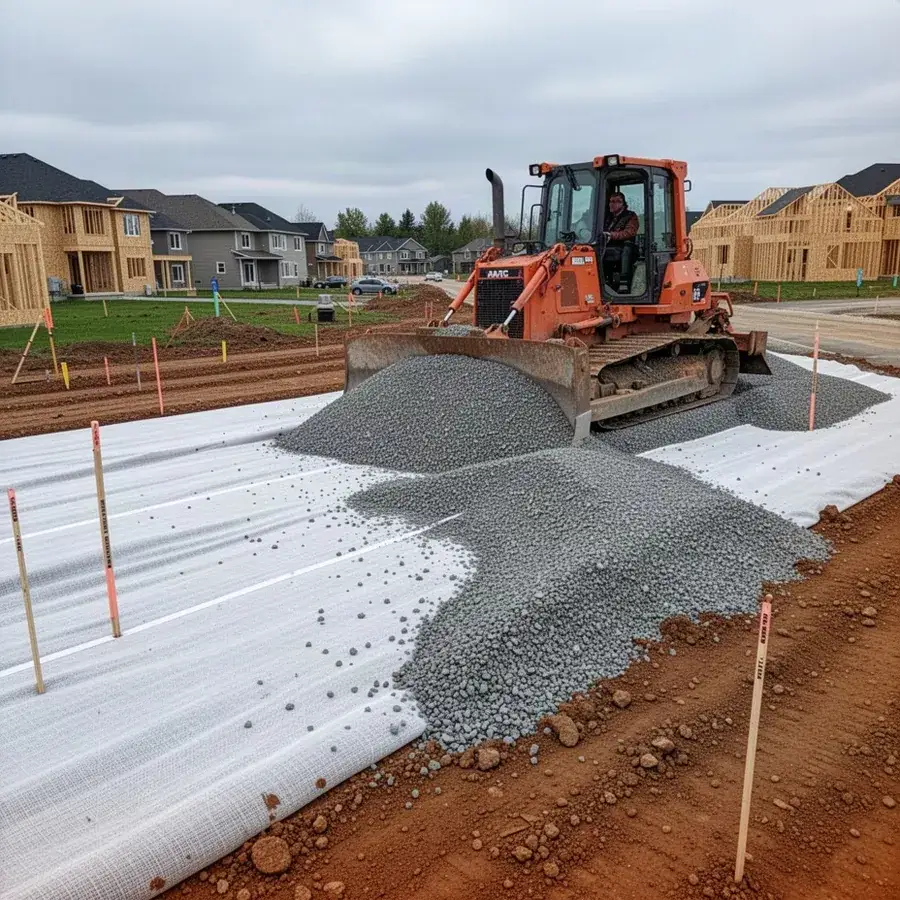
Temporary haul roads keep trucks out of the mud on active job sites and stop tracking onto municipal streets. We build them with geotextile and coarse granular or recycled concrete, often with a mud mat at the site exit.
When the project ends, we remove the material or regrade it into the permanent base where the drawings allow.
How a Road Is Built From the Subgrade Up
A road is a stack of layers, each doing a specific job: the subgrade supports, the fabric separates, the Granular B spreads the load and the Granular A gives a tight, stable running surface. Get one layer wrong and the road ruts, potholes or heaves no matter how good the surface looks on day one.
Subgrade Preparation and Proof Rolling
The subgrade is the native soil left after topsoil and organics are stripped. We shape it to the design crossfall, compact it, then proof roll it with a loaded tri-axle dump truck or heavy roller and watch for any spot that pumps, ruts or deflects.
Soft areas are sub-excavated and replaced with granular, a step that matters in the silty clay and wet pockets found across much of Waterloo Region.
Geotextile Separation
A non-woven geotextile, typically an OPSS 1860 Class II fabric, goes down between clay subgrade and the first granular lift. It stops fine clay from pumping up into the stone under traffic, which is the slow process that turns a good base into mud.
On firm sandy or gravelly subgrades the engineer may leave it out, but on clay it is cheap insurance.
Granular B Subbase
Granular B is a coarser, well-graded sand and gravel or crushed material that forms the structural layer of the road. On private roads it is usually 300 to 450 mm (12 to 18 in) thick, placed in lifts and compacted to the specified percentage of Standard Proctor Maximum Dry Density.
It spreads wheel loads over a wide area so the weaker subgrade below never sees the full weight of a truck.
Granular A Base Course
Granular A is a 19 mm crushed stone with fines that locks together under compaction into a dense, smooth surface. It is usually 150 mm (6 in) thick and is the layer that asphalt is placed on, or that traffic drives on directly for a gravel road.
We fine grade it to the design elevations and crossfall before final compaction.
Drainage: Ditches, Culverts and Crossfall
Water is what destroys roads, so every road we build is shaped to move it off the surface and out of the base as fast as possible. A saturated granular base loses much of its strength, and in an Ontario winter that trapped water freezes, expands and heaves the road.
- Crossfall: a crown or one-way slope of about 2 percent for paved roads and 3 to 4 percent for gravel roads pushes water to the edges
- Ditches and swales: roadside ditches set below the bottom of the granular base so the base can drain sideways
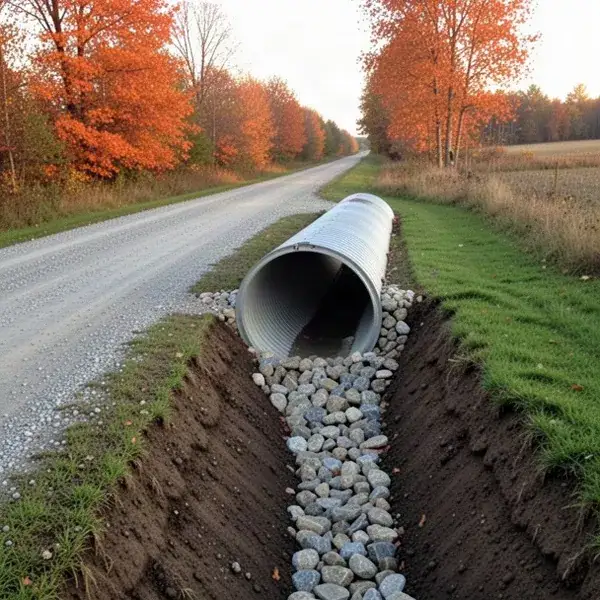
- Culverts: corrugated steel or HDPE pipes at entrances and low points, sized for the drainage area and set with proper bedding and cover
- Subdrains: perforated pipe in filter sock along the edge of the base where ditches are not possible
On larger projects culvert sizes come from the engineer's stormwater design. Ditching and culvert work also fall under our drainage excavation service, and roads near watercourses in Grand River Conservation Authority regulated areas may need a GRCA permit before work starts.
Our Road Construction Process
Most private roads follow the same four stages, from approved drawings to a finished grade. Every project starts with utility locates through Ontario One Call before the first bucket goes in the ground.
- 01
Engineering Drawings and Approvals
We build from approved drawings that set alignment, grades, granular depths and drainage. Subdivision roads come with an engineer's plan and profile drawings, while simple rural laneways may only need a site sketch and an entrance permit from the road authority.
If you do not have drawings yet, we can tell you what the municipality is likely to ask for and when an engineer is needed.
- 02
Clearing, Stripping and Cut-Fill
Trees and brush are cleared, topsoil is stripped and stockpiled, and the corridor is cut and filled to the subgrade elevations. Excavated soil is balanced on site wherever possible, and any excess is managed under Ontario's excess soil rules, O. Reg. 406/19.
On wooded or overgrown routes, this stage overlaps with our land clearing service.
- 03
Placing and Compacting Granular
Granular B and then Granular A are placed in lifts, typically no thicker than 150 to 200 mm (6 to 8 in) compacted, and rolled with a vibratory smooth drum roller. On engineered projects a geotechnical firm tests density with a nuclear gauge before the next lift goes down.
Material is placed with a grader or dozer to keep thickness even across the full width.
- 04
Final Grade for Gravel or Paving
For a gravel road, the last pass is a fine grade of Granular A with the crown set and edges shaped into the shoulders. For a paved road, we fine grade and compact the base to the tolerances the paving contractor needs, then hand off the site.
Our scope ends at the finished granular base, and we coordinate timing directly with your paving contractor.
Gravel Roads vs Paved Roads
Gravel roads cost less to build, while paved roads cost less to maintain over time and are the norm for anything a municipality will assume. For a private road, the right answer depends on traffic volume, budget and how much ongoing grading you are prepared to do.
- Gravel (Granular A surface): lowest upfront cost, easy to repair and widen, but needs periodic grading, top-up stone and dust control
- Paved (asphalt over granular): higher upfront cost, smoother and easier to plow, and typically lasts 15 to 25 years with crack sealing
- Staged approach: build the full granular base now, drive on it for a season or two, then pave once settlement is done
Gravel makes sense for farm lanes, low-traffic rural roads and laneways serving one to three homes. Paving makes sense for shared roads with steady traffic, steep grades where gravel washes out and any road the municipality will eventually take over.
Road Construction Cost Factors
Road construction is priced on length, width and the depth of material needed, with soil conditions and drainage often making the biggest difference. Two roads of the same length can vary widely in cost if one sits on firm sand and the other crosses wet clay.
- Length and width: single-lane laneways of about 4 m versus two-lane roads of 7 m or more
- Subgrade conditions: soft clay, organics or high groundwater mean sub-excavation and extra granular
- Base depth: heavier traffic means thicker Granular B
- Drainage: ditch length, culvert crossings and any subdrains
- Clearing and earthworks: trees, stumps, topsoil stripping and cut-fill volumes
- Excess soil: trucking and disposal of soil that cannot stay on site
- Surface: gravel finish versus a base prepared for asphalt
- Engineering and testing: drawings, permits and compaction testing
We price each road after walking the route. The quote lists granular quantities and depths so you can compare bids on the same basis.
Where We Provide Road Construction
We provide road construction from our Cambridge yard to homes, farms and businesses within about a 30-minute drive of Cambridge. Choose your community for local permit, soil and neighbourhood details.
Road Construction FAQs
How thick should the gravel base be for a private road?
Most private roads need about 300 to 450 mm (12 to 18 in) of Granular B with 150 mm (6 in) of Granular A on top. Roads on soft clay or carrying heavy trucks may need more, which an engineer or proof roll will confirm.
How long does it take to build a private road?
A short rural laneway can be built in a few days, while a longer private road may take 2 to 4 weeks of site work. Approvals, permits and engineering often take longer than the construction itself, so start that early.
Do you pave roads as well?
Our work covers everything up to a finished, compacted granular base. For paved roads we coordinate directly with your asphalt paving contractor so the base is ready on the day they arrive.
What is OPSS Granular A?
Granular A is a crushed stone or crushed gravel aggregate, with particles up to about 19 mm, defined in Ontario Provincial Standard Specification OPSS 1010. Its blend of stone and fines compacts into a dense, stable layer, which is why it is the standard base course under asphalt and the running surface on gravel roads.
Plan Your Road Project
Whether it is a farm lane in Woolwich or a subdivision street in Cambridge, the base we build is what you will be driving on for decades. Tell us about the route and we will walk it with you and price it layer by layer.
Building a commercial site? We also handle parking lot construction and full site preparation so the roads, lots and building pad are built as one project.
- Fennex Cambridge Excavation Pros
- 725 Briardean Rd, Cambridge, ON N3H 4R6
- +1 226-894-8631
- info@fennexexcavation.ca
- Mon to Sat 7:00am to 9:30pm
Sun 9:00am to 9:00pm