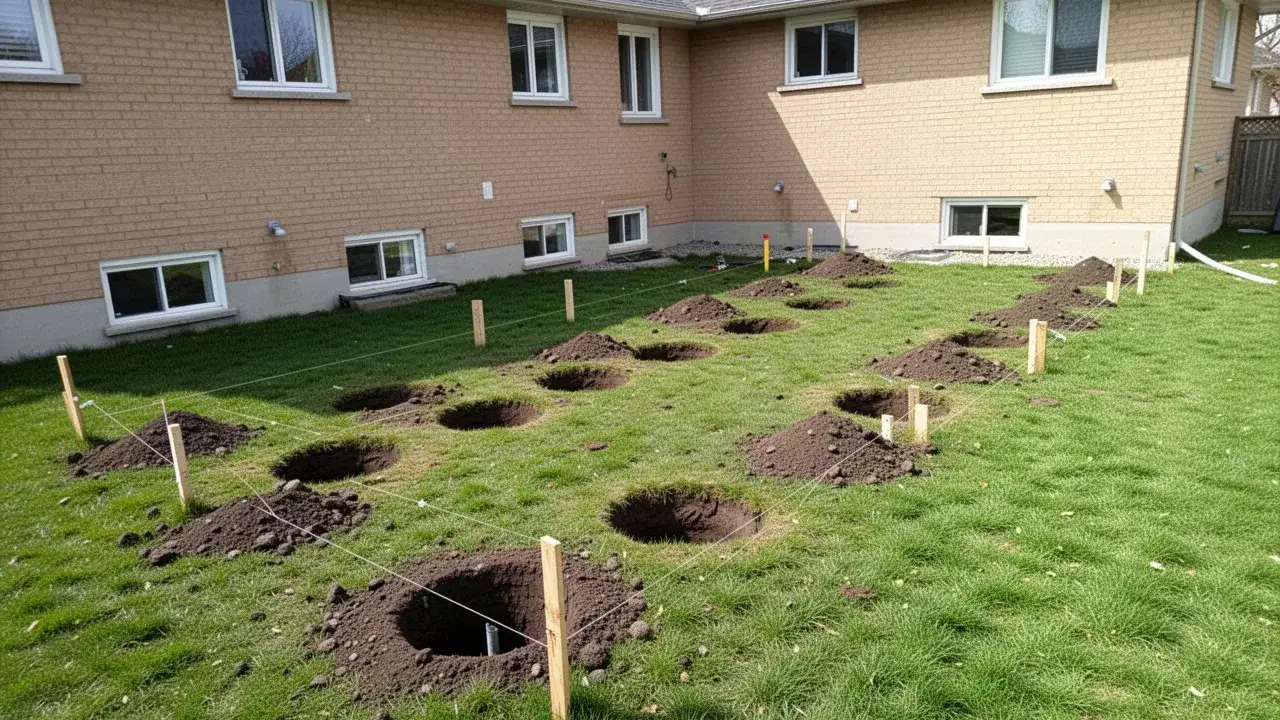
Deck Footing and Post Hole Augering
Post Hole Digging and Deck Footings in Cambridge, ON
Fennex Cambridge Excavation Pros augers post holes for deck footings, fences, pole barns, signs and light standards across Cambridge and Waterloo Region. We bring a hydraulic auger on a compact machine, drill each hole to the depth and diameter on your plans and leave the site ready for concrete.
Our post hole calls come from homeowners building their own deck, deck and fence contractors who want holes done before their crew arrives, and farmers running new fence lines or putting up post-frame buildings. Sign and lighting installers call us for deeper, larger-diameter holes.
After more than 40 years of digging in local soils, we know why machine augering beats a shovel. A hydraulic auger drills a clean, round, plumb hole through clay and stony till in minutes, reaches true frost depth every time and saves your back and your schedule.
Our Post and Pole Hole Digging Services
We drill holes from about 150 mm (6 in) up to 600 mm (24 in) in diameter, to depths of 1.2 m (4 ft) and deeper where the design calls for it. Every job includes layout checks, depth verification on each hole and cleanup of the spoil.
We work directly with your deck or fence builder so the holes line up with their layout and are ready the day they set tubes or posts. For bigger yard projects, the same compact machine can handle regrading through our mini excavator and Bobcat services.
Deck and Porch Footings
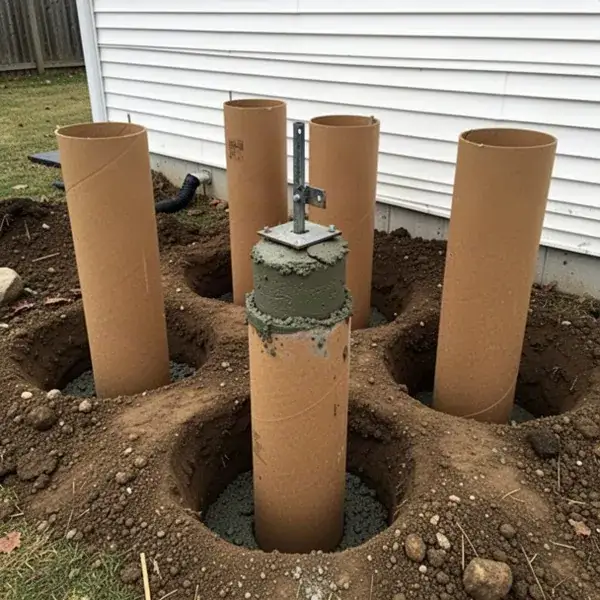
Deck and porch footings are holes drilled below frost so a concrete pier in a sonotube can carry the deck without heaving. Typical holes are 250 to 400 mm (10 to 16 in) across to suit 200 to 300 mm (8 to 12 in) tubes or bell-shaped footing forms.
We drill to the depth shown on your permit drawing, usually at least 1.2 m (4 ft) below finished grade.
Fence Post Holes
We dig holes for wood privacy fences, chain link, pool enclosures and long farm fence runs. Residential fence posts usually go 0.9 to 1.2 m (3 to 4 ft) deep, while gate posts and corner posts benefit from the full 1.2 m.
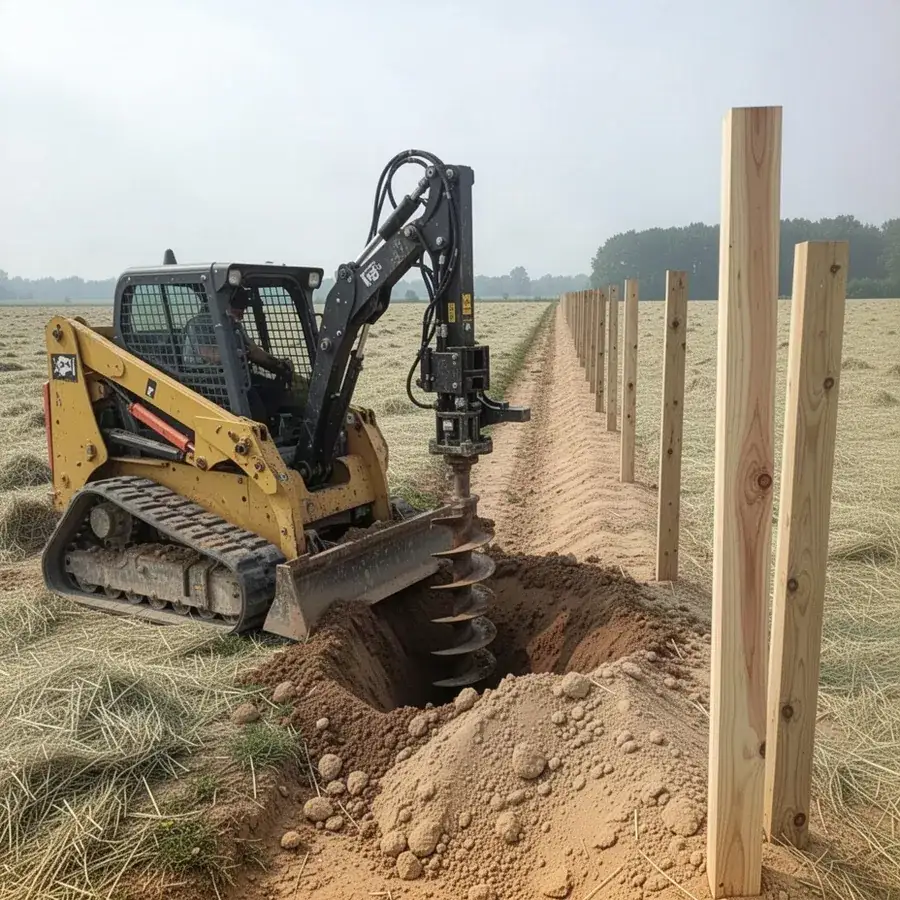
On farms, a skid steer auger works down a long line quickly, and we can clear brush along the fence line first through our land clearing service.
Pole Barns, Signs and Light Standards
Post-frame buildings, pylon signs and parking lot light standards need larger, deeper holes sized by an engineer. These are commonly 450 to 600 mm (18 to 24 in) across and 1.2 to 2.4 m (4 to 8 ft) deep, depending on wind load and soil.
Holes this big need a heavier auger drive and a mini excavator or track loader that can hold it steady.
How Deep Do Footings Need to Be in Ontario?
Footings in Ontario need to sit below the frost line, which is 1.2 m (4 ft) below grade in most Waterloo Region soils. That depth is the common requirement the Ontario Building Code sets for footings in frost-susceptible soils, and your permit drawings confirm it for your site.
Building departments in Cambridge, Kitchener and Waterloo generally require a permit for decks attached to the house or more than 600 mm (24 in) above grade. The inspector may check hole depth before concrete, so we dig to the drawing every time.
Frost Depth for Deck Footings
When water in the soil freezes, it expands and lifts anything sitting above the frost line. A footing only 600 mm deep in clay can rise 25 mm or more in a hard winter and settle back unevenly in spring.
That movement pulls deck ledgers away from the house, racks railings and cracks concrete steps. Drilling to 1.2 m puts the bottom of the pier below the freeze, which is the cheapest insurance a deck can have.
Footing Diameter and Bearing
The wider the footing, the more load it spreads into the soil, so diameter is set by the weight each post carries and the bearing capacity of the ground. Your deck designer or the building department's span tables give each footing size based on beam spans and post spacing.
Many builders use a bell-shaped base at the bottom of a narrower tube to gain bearing area. We size the auger bit to fit that form with room to backfill around it.
Deck Footing Options Compared: Sonotubes, Helical Piles and Deck Blocks
Augered holes with sonotubes are the most common choice for permitted decks, but they are not the only one. Helical piles and precast deck blocks each have a place, and we would rather you pick the right one than pay for holes you do not need.
Augered Holes With Sonotubes
A sonotube is a cardboard form set in an augered hole and filled with concrete to make a round pier. It is the standard footing on most permit drawings in the region because it is proven, inspectable and reasonably priced.
The trade-off is time, since concrete needs to cure before framing and the spoil has to go somewhere.
Helical Piles
Helical piles are steel shafts with screw plates that are turned into the ground by a hydraulic drive, with no digging and no concrete. Installation torque is monitored to confirm capacity, and the deck can be framed the same day.
They often cost more per footing than augered piers but make sense on wet ground, near foundations or where spoil cannot be removed. Specialist pile installers do this work, not post hole crews.
Precast Deck Blocks
Deck blocks are precast concrete pads that sit on the surface or a shallow gravel bed. They are fine for low, freestanding floating decks but are not frost-protected, so they move with the seasons.
Most building departments will not accept them for decks attached to the house or built high off the ground.
Augers and Machines We Use
We mount hydraulic auger drives on compact track loaders, skid steers and mini excavators, choosing the machine by hole size and access. A planetary auger drive delivers high torque at low speed, which is what drills through dense clay and till without stalling.
Bits range from 150 mm (6 in) fence bits up to 600 mm (24 in) structural bits, with carbide rock teeth for stony ground. Because the machine holds the auger steady, the hole comes out plumb and round, unlike the wandering holes a two-person handheld auger leaves.
Compact machines also reach places a truck-mounted drill cannot. For backyard jobs we bring the smallest machine that will do the work cleanly.
How a Post Hole Job Goes
A typical deck footing job is finished in a few hours, and most fence jobs in a day. Here is how the day runs.
- 01
Locates and Layout Marks
Every job starts with free utility locates from Ontario One Call, even for a short fence. Fence lines run right along property lines, which is exactly where gas services, buried hydro and fibre cables often sit.
Your builder or our crew marks each hole with paint or a stake, and we check spacing against the drawing before drilling.
- 02
Augering to Depth
We drill each hole in a few passes, lifting the auger to clear spoil so the walls stay clean. Depth is checked on every hole with a tape or grade rod against a fixed reference, not guessed from the auger length.
If a hole comes up short because of rock or roots, we stop and sort it out before moving on.
- 03
Spoil Cleanup and Ready for Concrete
A 300 mm hole 1.2 m deep produces about 0.1 m³ of soil, and a 12-footing deck adds up quickly. We spread it on site where you want it, pile it neatly for your landscaper or haul it away.
Holes are left clean and covered if needed, ready for the builder to set tubes and pour.
Digging Through Rock, Roots and Clay
Boulders, tree roots and heavy clay are the usual reasons a post hole stops short, and each has a fix. The key is a machine with enough torque and a crew that knows when to switch tools.
Glacial till around Cambridge and Puslinch is full of fieldstone, so when an auger hits a boulder we try a rock bit first, then dig it out with the excavator bucket. If a stone is too large, the hole can sometimes be shifted with the designer's approval. Near mature maples, a root-cutting bit or a quick saw cut clears roots.
Wet clay grabs the auger and smears the hole walls, so we drill in shorter lifts. On farm fence jobs in rural areas such as Puslinch, stony ground is expected and we bring rock-capable bits from the start.
Post Hole Digging Prices
Post hole digging is priced either per hole or by the hour, usually with a minimum charge to cover bringing the machine to site. As a general guide, machine-augered holes in Waterloo Region often run about $40 to $120 each, depending on diameter, depth and ground.
- Depth and diameter: a 600 mm structural hole takes far longer than a 200 mm fence hole.
- Number of holes: larger jobs spread the trucking cost and lower the price per hole.
- Access: backyards behind fences need a smaller machine and more time.
- Ground: rock, roots and wet clay slow the auger.
- Spoil handling: spreading on site costs less than haul-away.
Send us your drawing or hole count for a firm price, or book a free site visit for larger farm and commercial jobs.
Where We Provide Post and Pole Hole Digging
We provide post and pole hole digging from our Cambridge yard to homes, farms and businesses within about a 30-minute drive of Cambridge. Choose your community for local permit, soil and neighbourhood details.
Post Hole and Deck Footing FAQs
How deep should deck footings be in Ontario?
In most cases 1.2 m (4 ft) below grade, which keeps the footing below frost. Always confirm against your permit drawings.
Do I need locates to dig fence post holes?
Yes. Fence lines follow property lines where gas, hydro and communication cables often run, and Ontario One Call locates are free.
How many post holes can you dig in a day?
A typical deck of 8 to 12 footings is usually done in a morning. Long fence lines in clean soil can reach several dozen holes a day, while rock or tight access slows that down.
Can your machine fit in a fenced backyard?
Usually yes. A compact machine fits through a gate of about 1.0 to 1.5 m (40 to 60 in), and a fence panel can be removed if needed.
Book Your Post Hole Digging
Deck builders, fence installers and homeowners, send us your layout and hole count and we will fit you into the schedule. We answer calls seven days a week, so you can book holes for the weekend build without missing a day.
- Fennex Cambridge Excavation Pros
- 725 Briardean Rd, Cambridge, ON N3H 4R6
- +1 226-894-8631
- info@fennexexcavation.ca
- Mon to Sat 7:00am to 9:30pm
Sun 9:00am to 9:00pm