Erosion and Sediment Control
Erosion and Sediment Control in Cambridge, Ontario
Fennex Cambridge Excavation Pros installs erosion and sediment controls and stabilizes slopes, ditches and creek banks across Cambridge, Waterloo Region and Guelph. We have been moving earth in the Grand River watershed for more than 40 years, so we know how quickly bare soil washes out once the sod is stripped.
Builders and site contractors call us to meet erosion and sediment control (ESC) conditions on site plans, subdivision agreements and conservation authority permits. Homeowners call when a backyard slope is slumping, a creek is eating into the lawn, or every storm leaves silt across the driveway.
Much of this work sits inside areas regulated by the Grand River Conservation Authority (GRCA). That means installing controls exactly as the permit drawings show and keeping them working until the ground is stable.
Our Erosion Control Services
We provide sediment control for active construction sites, long-term stabilization for slopes, and armouring for creek and pond banks. Every job starts with how water moves across the site.
Construction Site Sediment Control
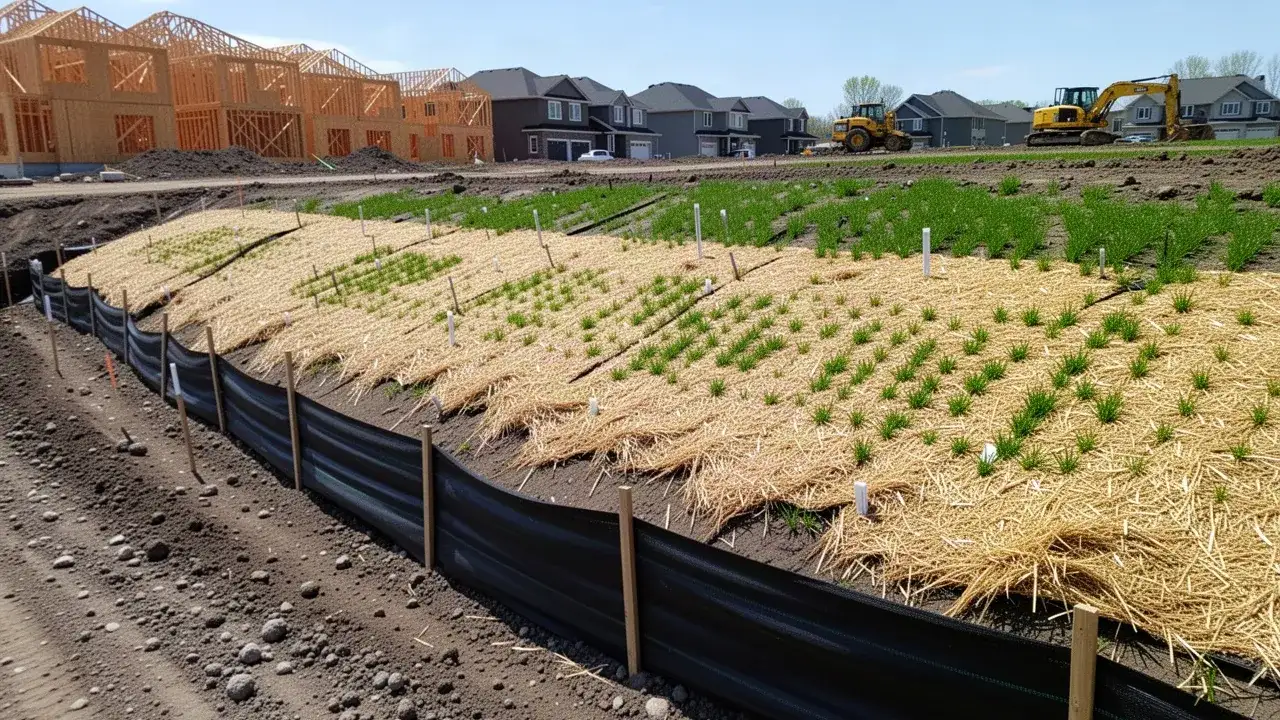
Construction sediment control keeps soil on your site and out of storm sewers, ditches and streams while earthworks are underway. We install perimeter silt fence, clear stone mud mats at entrances, catch basin inserts and sediment traps as your approved ESC plan shows them.
This suits builders, developers and commercial owners with site plan conditions to meet. It pairs naturally with our site preparation services, so controls go in on the same mobilization as stripping and grading.
Slope and Embankment Stabilization
Slope stabilization stops surface erosion and shallow slumping on embankments, berms and backyard hills. Where space allows, we first flatten the slope to a stable angle through grading and levelling, then cover it with erosion control blankets, topsoil and seed, or plantings.
Residential lots backing onto ravines and commercial sites with steep stormwater pond banks are typical clients. Taller slopes, or any sign of deep movement, need a geotechnical engineer's design first.
Creek and Shoreline Protection
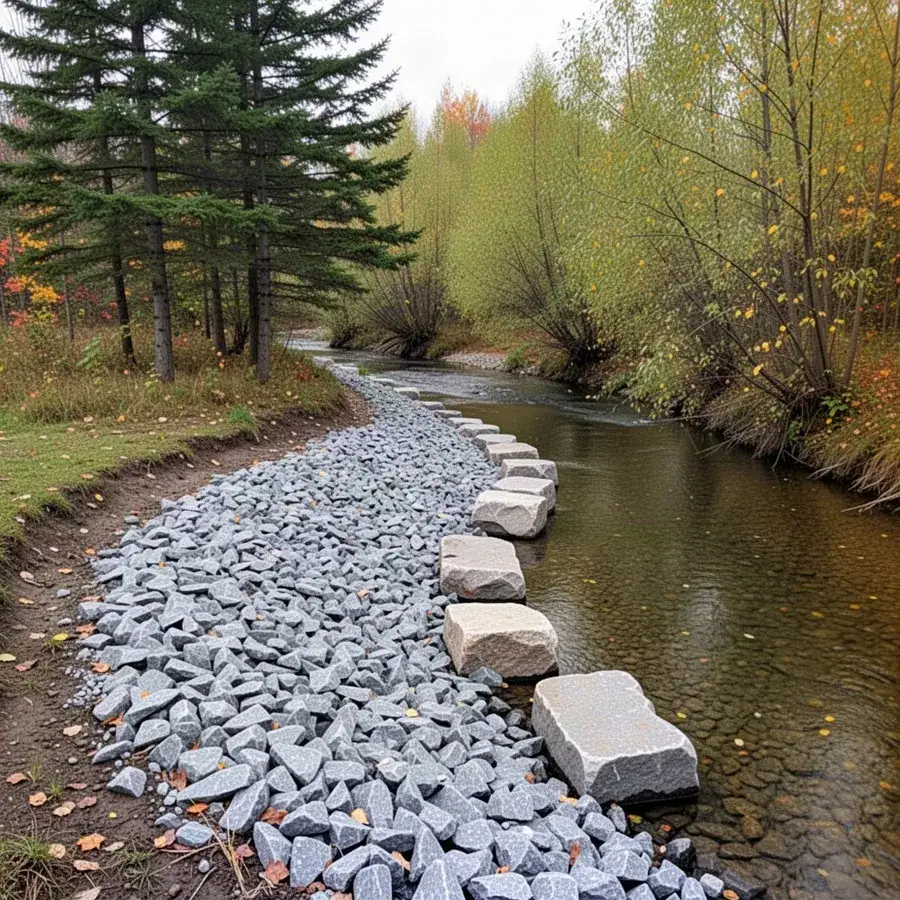
Creek and shoreline protection armours banks that are being undercut by flowing water. Depending on the flow, we use rip rap over geotextile, armour stone, or softer bioengineering such as live willow stakes and coir logs.
This is common on properties along tributaries of the Grand and Speed rivers, such as Mill Creek, which runs through Cambridge and our Puslinch excavation service area. Work at or near the water almost always needs a GRCA permit first.
Erosion Control Methods We Install
We choose erosion control methods by slope, flow speed and how long the protection has to last. Temporary measures hold soil during construction, and permanent ones take over afterward.
Silt Fence and Straw Wattles
Silt fence is geotextile fabric on stakes, with its bottom edge buried about 150 to 200 mm (6 to 8 in) in a trench so water cannot run underneath. It slows sheet flow so sediment settles out before water leaves the site.
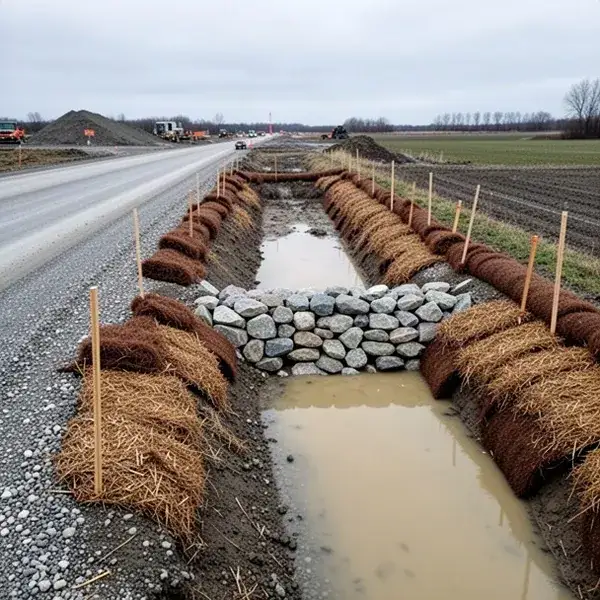
Straw wattles, also called fibre rolls, are long tubes of straw or coir staked across slopes and ditch lines. They break up runoff on long slopes and work where a fence is impractical, such as along curbs.
Erosion Control Blankets
Erosion control blankets are biodegradable mats of straw, straw and coconut, or pure coir held together with netting. They are pinned across graded slopes to shield seed and topsoil from rain until roots take hold.
Straw blankets break down in about a year and suit gentle slopes. Coir blankets last several years and suit steeper banks and swales with concentrated flow.
Rip Rap and Armour Stone
Rip rap is a layer of angular quarried stone placed over non-woven geotextile to absorb the energy of fast-moving water. Stone size is matched to the flow, from about 150 mm (6 in) at ditch outlets to 300 to 600 mm (12 to 24 in) on creek banks.
Armour stone is large, squared limestone blocks, often a tonne or more each, stacked into a stepped wall along shorelines and steep banks. It costs more than rip rap but gives a durable, finished edge.
Check Dams and Sediment Traps
Check dams are small berms of clear stone or rock built across a ditch or swale to slow water and let sediment drop out. Spaced so the toe of one sits level with the crest of the next, they turn a fast channel into a series of calm pools.
Sediment traps are excavated basins at low points that hold runoff long enough for soil particles to settle. They are sized to the drainage area shown on the ESC plan.
Conservation Authority Permits and Erosion Control Plans
Work inside a regulated area needs a GRCA permit, and most construction sites need an approved erosion and sediment control plan. Regulated areas include river and stream valleys, floodplains, wetlands, shorelines and the allowances around them.
Since April 1, 2024, conservation authority permits fall under Ontario Regulation 41/24, which replaced O. Reg. 150/06. Grading, filling and placing material within a regulated area count as development, so even a backyard regrade near a creek can need a GRCA permit under Ontario Regulation 41/24.
GRCA confirms whether an application is complete within 21 days and aims to make a decision within 90 days. Its online Map Your Property tool shows whether your lot falls inside the regulated area.
Municipalities such as Cambridge, Kitchener, Waterloo and Guelph typically make an ESC plan a condition of site plan approval, subdivision agreements and grading permits. The plan is usually prepared by the project engineer and specifies measures built to OPSS 805, the Ontario Provincial Standard for temporary erosion and sediment control.
Work in or near fish habitat may also need review under the federal Fisheries Act, and in-water work is limited to timing windows that protect spawning fish. We build what the approved drawings show and flag any field condition that does not match before it becomes a compliance problem.
Our Erosion Control Process
Our erosion control process runs in four stages, from plan review to removal. The goal is that sediment never leaves your site and the ground ends up stable on its own.
- 01
Site Assessment and Plan Review
We start by reviewing the approved ESC plan, or by walking the problem area if there is no plan yet. We look at drainage areas, slope length and steepness, soil type and where runoff leaves the property.
On homeowner jobs we also look for the water source, such as a downspout or sump outlet discharging at the top of a bank. Fixing the source is often cheaper than armouring the damage.
- 02
Installing Controls Before Earthworks
Controls go in before any topsoil is stripped or any grading begins. Perimeter silt fence, the construction entrance mud mat and catch basin protection come first, followed by check dams and sediment traps at low points.
Installing controls first is a standard condition of most site plans and GRCA permits. It also spares you the cost of cleaning silt out of a municipal storm sewer.
- 03
Inspection After Storms
Erosion controls need inspection after every significant rainfall and at regular intervals during construction. Inspectors look for undermined or overtopped silt fence, full sediment traps and torn blankets.
Sediment is cleaned out once it reaches roughly half the height of a fence or half the depth of a trap. Damaged sections should be repaired before the next forecast storm.
- 04
Removal After Stabilization
Temporary controls come out once the disturbed area is stabilized, usually when permanent vegetation forms a dense, even cover. Many municipalities and the GRCA expect sign-off before removal.
We pull the fence and stakes, spread or haul away trapped sediment, and seed any ground disturbed during removal. Biodegradable blankets and wattles are left in place to break down.
Signs of Erosion on Your Property
The clearest signs of erosion are new gullies, exposed roots, slumping banks and sediment showing up where it should not be. Catching them early usually means a smaller, cheaper repair.
- Gullies and rills: narrow channels cut into a slope or lawn after heavy rain, often below a downspout or sump outlet.
- Exposed tree roots: soil washing away from the base of trees on a slope or creek bank.
- Slumping or cracked banks: soil sagging, bulging at the bottom or showing crescent-shaped cracks near the top.
- Undercut creek banks: an overhanging lip of sod with the bank hollowed out below it, usually on the outside of a bend.
- Sediment on hard surfaces: fans of silt across driveways, walkways and patios after every storm.
- Leaning fences and walls: posts and retaining walls tipping downhill as soil moves out from beneath them.
Crescent cracks, leaning trees or any movement near a foundation suggest a deeper slope problem that needs a geotechnical assessment first. When surface water is behind the erosion, drainage excavation and French drains often solve the cause.
Erosion Control Cost Factors
Erosion control cost depends on the area treated, slope steepness, materials, site access and permit requirements. Temporary sediment control for a single house build is usually a modest line item, while armour stone shoreline work is a major project.
As a general Waterloo Region range, perimeter silt fence typically runs about $8 to $20 per linear metre installed. Rip rap and armour stone are priced by the tonne delivered and placed, and bank protection projects often reach well into five figures.
- Area and length: linear metres of fence and square metres of blanket or stone.
- Slope and flow: steeper slopes and faster water need heavier products, such as coir instead of straw or larger rip rap.
- Materials: geotextile grade, blanket type, stone size, armour stone tonnage and plant stock.
- Access: creek banks and ravine lots may need a smaller machine, ground protection mats or a long-reach excavator.
- Permits and engineering: GRCA permit fees, engineered drawings and any geotechnical report.
- Maintenance period: how many months the controls must be inspected and cleaned before stabilization.
These figures are general market ranges. The firm number comes from a free site visit and a review of any approved drawings.
Where We Provide Erosion Control
We provide erosion control from our Cambridge yard to homes, farms and businesses within about a 30-minute drive of Cambridge. Choose your community for local permit, soil and neighbourhood details.
Erosion Control FAQs
What is the difference between erosion control and sediment control?
Erosion control stops soil from moving in the first place, while sediment control catches soil after it starts moving. Blankets, seeding and rip rap are erosion controls; silt fence, check dams and sediment traps are sediment controls.
A good plan leans on erosion control first, since holding soil at the source is cheaper and more reliable than trapping it downstream.
Do I need a permit to work near a creek?
Usually yes. If your property is inside a GRCA regulated area, grading, filling, building or altering a watercourse needs a permit under O. Reg. 41/24 before work starts.
The GRCA Map Your Property tool shows whether your lot is regulated. In-water work may also need federal Fisheries Act review.
How long does silt fence need to stay up?
Silt fence stays up until the area it protects is stabilized by established vegetation or a final hard surface such as paving. On a house build, that often means the full construction period plus enough of a growing season for sod or seed to root.
Removing it before the municipality or conservation authority signs off can lead to an order to reinstall it or a delay in releasing site securities.
What is the best way to stop a slope from eroding?
The best method depends on the slope angle and how much water flows over it. Gentle slopes usually need only topsoil, seed and an erosion control blanket, while steep or wet slopes may need coir, terracing, rip rap or armour stone.
Redirecting water away from the top of the slope is always step one. Deep-seated movement needs a geotechnical engineer before any repair.
Protect Your Site or Slope
Whether you need permit-ready sediment controls before breaking ground or a lasting fix for a bank that keeps washing out, we will help you get it right the first time.
Erosion problems usually start with water, so we often combine this work with drainage excavation for yards and ditches and site preparation for new builds.
- Fennex Cambridge Excavation Pros
- 725 Briardean Rd, Cambridge, ON N3H 4R6
- +1 226-894-8631
- info@fennexexcavation.ca
- Mon to Sat 7:00am to 9:30pm
Sun 9:00am to 9:00pm