Lot Clearing Contractors
Land Clearing and Lot Clearing in Cambridge, ON
Fennex Cambridge Excavation Pros clears building lots, overgrown acreage and fence lines across Cambridge, the surrounding townships and Waterloo Region. We remove trees, brush, stumps and roots, then leave a clean, rough-graded surface ready for the next stage of your project.
Our calls come from rural owners in places like Puslinch and Wilmot, from builders who need a footprint opened up, and from farmers reclaiming pasture that has gone to buckthorn and scrub. After more than 40 years in local earthworks, we know that the hard part of clearing is rarely the cutting.
The hard part is knowing what you are allowed to remove and when. We plan every job around woodland bylaws, bird nesting season and conservation authority limits, so the trees you want to keep stay standing and the work does not stop for a stop-work order.
Our Land Clearing Services
Our land clearing service covers tree and brush removal, stump extraction, grubbing and the disposal or reuse of everything we cut. It suits anyone who needs open, usable ground: a future house site, a hay field, a fence line or a utility corridor.
We size the equipment to the job, from compact track loaders with mulching heads on tight lots to excavators with thumbs for pulling large stumps on acreage.
Building Lot Clearing
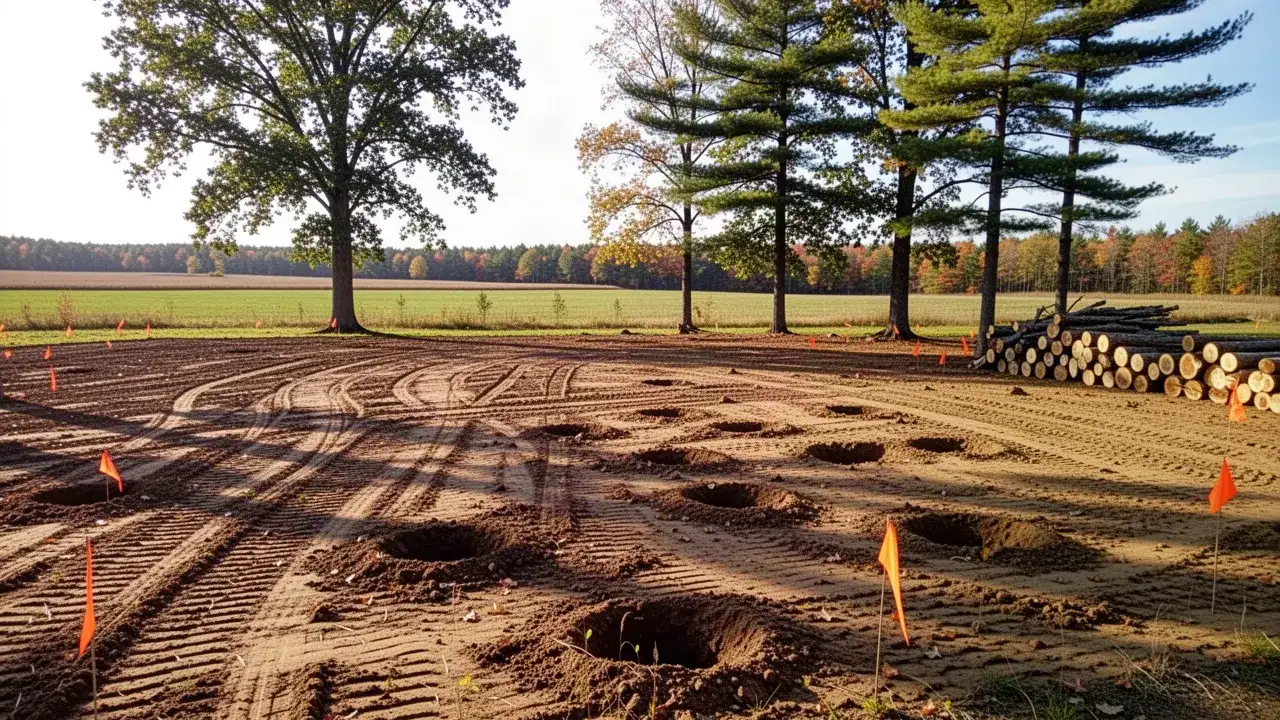
Building lot clearing opens up the house footprint, the driveway, the septic bed area and a working margin around the foundation. We grub everything inside the building envelope so no roots are left to rot under footings or a garage slab.
Trees outside the envelope that you want to keep are fenced at the drip line before machines arrive. Compacting soil over the root zone kills mature maples and oaks slowly, often two or three years after the house is finished.
Acreage and Field Clearing
Acreage clearing reclaims old pasture and field edges that have filled in with buckthorn, hawthorn, sumac and young poplar. We mulch or remove the growth, pull the larger stumps and leave the ground ready for tilling or seeding.
Common buckthorn is an invasive shrub across southern Ontario and resprouts hard from cut stumps. We grub or mulch below grade on buckthorn so it does not come back thicker the next season.
Fence Line and Trail Clearing
Fence line and trail clearing cuts a narrow, clean corridor, usually 3 to 6 m (10 to 20 ft) wide, for new fencing, farm lanes, walking trails or buried utility runs. A mulching head works well here because it leaves a firm, walkable surface without piles to haul.
We confirm the property line with your survey first. Clearing onto a neighbour's land is one of the most common and expensive mistakes in rural clearing.
Forestry Mulching vs Full Clearing and Grubbing
Forestry mulching is best when you want the land opened up but not built on, and full clearing and grubbing is required when the ground must carry a foundation, driveway or septic bed. The difference is what happens to the roots and the organic material.
Mulching leaves shredded wood on site as a ground cover. Grubbing removes it so the mineral soil underneath can be compacted.
Forestry Mulching
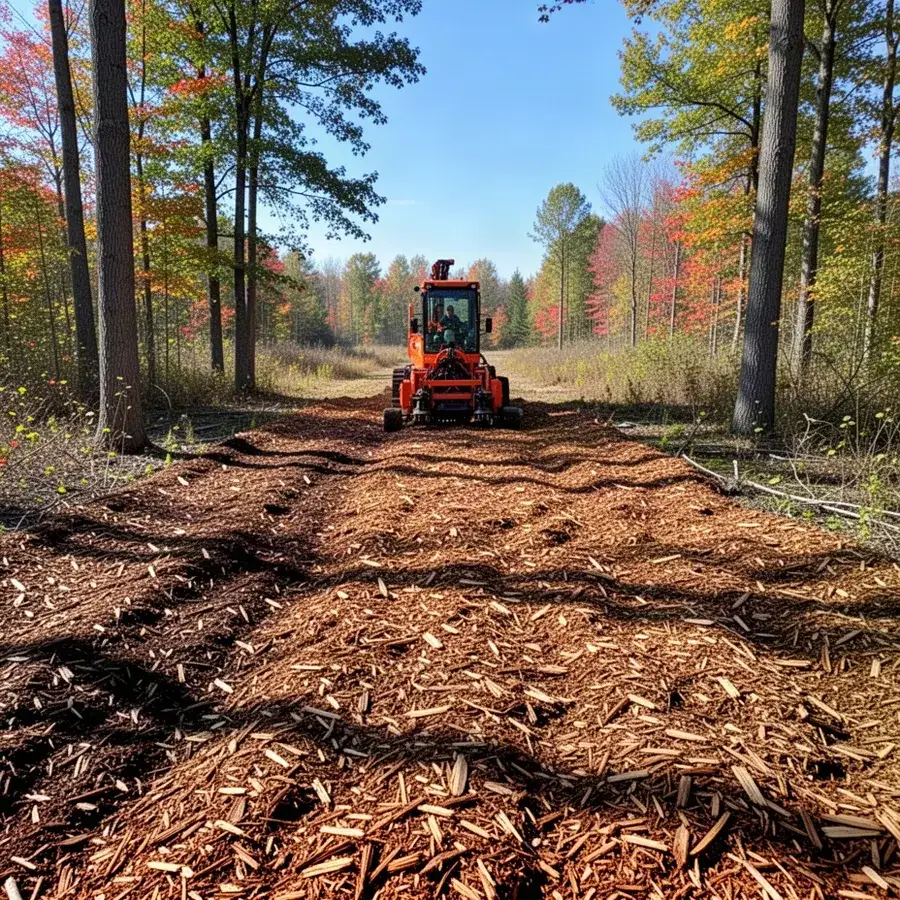
A forestry mulcher is a rotating drum of carbide teeth, mounted on a tracked carrier, that grinds standing brush and small trees into a layer of chips in one pass. It handles stems up to roughly 150 to 200 mm (6 to 8 in) efficiently and leaves very little soil disturbance.
The mulch layer holds soil on slopes and suppresses regrowth for a season or two. It is the fastest and usually cheapest way to open up trails, sightlines, fence lines and overgrown back acreage.
Clearing and Grubbing for Construction
Clearing and grubbing removes trees, stumps, roots and the organic root mat so only mineral soil is left. It is the first step of site preparation for a new building and is not optional under a foundation or driveway.
Wood buried under a structure decays and leaves voids, and mulch mixed into fill makes it impossible to compact. Building inspectors and geotechnical engineers will reject a subgrade that still has organics in it.
Stump Removal
Stumps can be ground down or excavated out, and the right choice depends on what goes on top. Grinding takes the stump 150 to 300 mm (6 to 12 in) below grade and suits lawns and gardens, but it leaves the root system to decay in place.
Excavating pulls the stump and main roots out whole with an excavator, then the hole is backfilled and compacted. Anywhere a building, driveway, pool or septic system is planned, the stumps should be excavated, not ground.
Tree Bylaws and Timing Rules Before You Clear
Before you clear land in Waterloo Region or Wellington County, check three things: the municipal or regional tree bylaw, the federal bird nesting rules and whether the property is in a conservation authority regulated area. Any one of them can require a permit or change when the work can happen.
Municipal and Regional Tree Bylaws
The Region of Waterloo Woodland Conservation By-law (By-law 08-026) regulates cutting in woodlands of one hectare (2.47 acres) or more that meet minimum tree densities. Wellington County's Forest Conservation By-law sets a similar one-hectare threshold for townships such as Puslinch and Guelph/Eramosa.
Inside the City of Guelph, the Private Tree Protection By-law has applied to trees 10 cm in diameter or larger on lots over 0.2 hectares, and the City has been reviewing it to cover more trees. Individual cities, including Cambridge, Kitchener and Waterloo, also protect boulevard trees and may have their own private tree rules, so we confirm the current bylaw for your address before quoting.
Bird Nesting Season
The federal Migratory Birds Convention Act and the Migratory Birds Regulations, 2022 prohibit disturbing or destroying active nests of most native birds. In southern Ontario the main nesting period runs roughly from early April to the end of August.
Clearing during that window is not banned outright, but it carries a real risk of a violation. If spring clearing cannot wait, a qualified biologist can complete a nest search shortly before cutting and mark any active nests to be left alone.
Conservation Authority Regulated Areas
Land near wetlands, creeks, rivers, floodplains and steep valley slopes is often regulated by the Grand River Conservation Authority under O. Reg. 41/24. Site grading and clearing that alters the land in those areas needs a GRCA permit first.
The GRCA's online Map Your Property tool shows whether a lot falls inside a regulated area. We check it on every rural job, and we install silt fence before clearing next to any watercourse.
Our Land Clearing Process
Our land clearing process runs in three stages: a site walk to mark what stays, the cutting and stumping, then debris removal and a rough grade. A typical half-acre building lot takes two to four days on site.
- 01
Site Walk and Marking Trees to Keep
We walk the property with you and flag the trees to keep, the clearing limits and the property lines from your survey. We also mark wells, septic tanks and beds, buried lines and soft or wet areas that machines should avoid.
If any digging is planned for stumps, we request Ontario One Call locates at this stage. Rural lots often have buried hydro or gas services running to outbuildings that nobody remembers.
- 02
Cutting, Mulching and Stumping
Larger trees are felled with chainsaws or processed with an excavator and grapple, and the logs are set aside if you want them. Brush and small trees go through the forestry mulcher, or are piled for chipping where the ground will be built on.
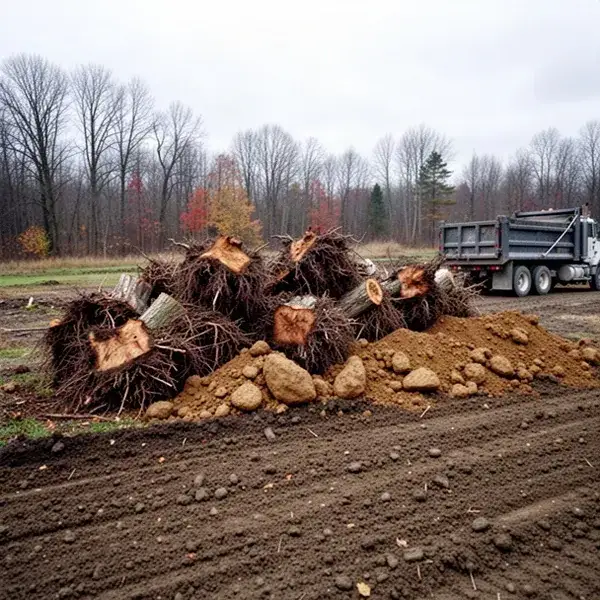
Stumps inside the construction area are pulled with an excavator, shaken free of soil to keep the topsoil on site and stacked for removal. On sandy moraine soils around Cambridge this is quick, while heavy clay till takes more time per stump.
- 03
Debris Removal and Rough Grading
Once cutting is done we haul or chip the debris, backfill the stump holes and track over the area to a clean rough grade. The site should drain and be safe to walk, with no root holes left open.
From here your lot is ready for topsoil stripping, a new gravel driveway or seeding, depending on your plans.
How Much Does Land Clearing Cost?
Land clearing cost in Waterloo Region usually comes down to how dense the growth is and whether the stumps have to come out. As a general range, light brush and small-tree mulching often runs about $2,500 to $5,000 per acre, while full clearing and grubbing of mature woodland can reach $6,000 to $12,000 or more per acre.
Small lots are usually priced per job rather than per acre, because mobilizing equipment is a fixed cost. Your firm price comes from a free site walk.
The main cost drivers are:
- Tree density and trunk size: a few large maples can take longer than an acre of thin scrub.
- Stump removal: grubbing for construction costs more than mulching to ground level.
- Slope and ground conditions: steep, wet or rocky ground slows machines and may need smaller equipment.
- Access: a narrow gate, septic bed or soft lawn between the road and the work area adds time and ground protection.
- Disposal: hauling stumps and logs off site costs more than chipping and spreading on the property.
- Permits and surveys: woodland permits, nest searches or GRCA approvals add time before work can begin.
What Happens to the Trees, Brush and Stumps
Most of what we clear is reused rather than landfilled. Logs can be cut to length for your firewood or sawlogs, brush becomes chips or mulch, and only stumps and soil-laden roots usually leave the site.
- Firewood and sawlogs: we leave usable hardwood stacked where you want it, and good-sized logs can go to a local sawmill.
- Wood chips and mulch: chipped or mulched material can stay on site for trails, garden beds or slope cover.
- Stumps and root balls: these go to a facility that grinds them for compost or fuel, because they are too dirty and dense to chip on site.
- Invasive species: buckthorn with ripe berries is not spread around the property, and any wood from ash trees stays local to respect firewood movement advice.
Burning brush is restricted or needs a permit in many local municipalities, so we do not count on it as a disposal method. Keeping the topsoil shaken off the stumps also means less soil leaves your property.
Where We Provide Land Clearing
We provide land clearing from our Cambridge yard to homes, farms and businesses within about a 30-minute drive of Cambridge. Choose your community for local permit, soil and neighbourhood details.
Land Clearing FAQs
How much does it cost to clear an acre of land in Ontario?
Clearing an acre in Ontario generally costs about $2,500 to $5,000 for light brush and mulching, and $6,000 to $12,000 or more for dense woodland with full stump removal. Density, trunk size, slope, access and disposal set the final price.
Do I need a permit to clear trees on my property?
You may need a permit if the trees are part of a woodland of one hectare or more, if your city has a private tree bylaw, or if the land is in a GRCA regulated area. Small residential lots outside regulated areas often need no permit, but we check before cutting.
When is the best time of year for land clearing?
Late fall and winter are the best times to clear land in southern Ontario. Frozen ground carries machines with less rutting, and the work falls outside the April to August bird nesting season.
Do you remove stumps and roots?
Yes. We grub out stumps and major roots with an excavator wherever something will be built, then backfill and compact the holes, and we can grind stumps instead in lawn and garden areas.
Book a Land Clearing Site Visit
Walk your property with us and we will mark what stays, check the permit and nesting rules, and give you a written price for clearing and disposal. Our office answers seven days a week, so a weekend site walk is easy to set up.
If you are clearing for a new home, ask about our land clearing work in Puslinch and the rest of our service area, and how we roll clearing straight into full site preparation for your build.
- Fennex Cambridge Excavation Pros
- 725 Briardean Rd, Cambridge, ON N3H 4R6
- +1 226-894-8631
- info@fennexexcavation.ca
- Mon to Sat 7:00am to 9:30pm
Sun 9:00am to 9:00pm