Cambridge Drainage Contractors
Drainage Excavation and French Drain Installation in Cambridge, ON
Fennex Cambridge Excavation Pros designs and digs drainage systems that move water away from homes, yards and rural driveways across Cambridge and Waterloo Region. With more than 40 years of excavation behind us, we install French drains, grassed swales, catch basins, culverts and replacement weeping tile on residential and commercial properties.
Most calls come from homeowners with a soggy backyard, ice sheets on the driveway or a damp basement corner that comes back every spring. Rural owners in Woolwich, Wilmot and Puslinch call us when a driveway culvert collapses or a roadside ditch backs up.
We find the cause before we dig. A drain that treats the wrong problem, or has no legal place to empty, is just money buried in the yard.
Our Drainage Excavation Services
We install four main drainage systems, and each one suits a different water problem. Water moving below the surface needs a French drain or new weeping tile, while runoff across the surface is usually better handled by a swale or culvert.
French Drain Installation
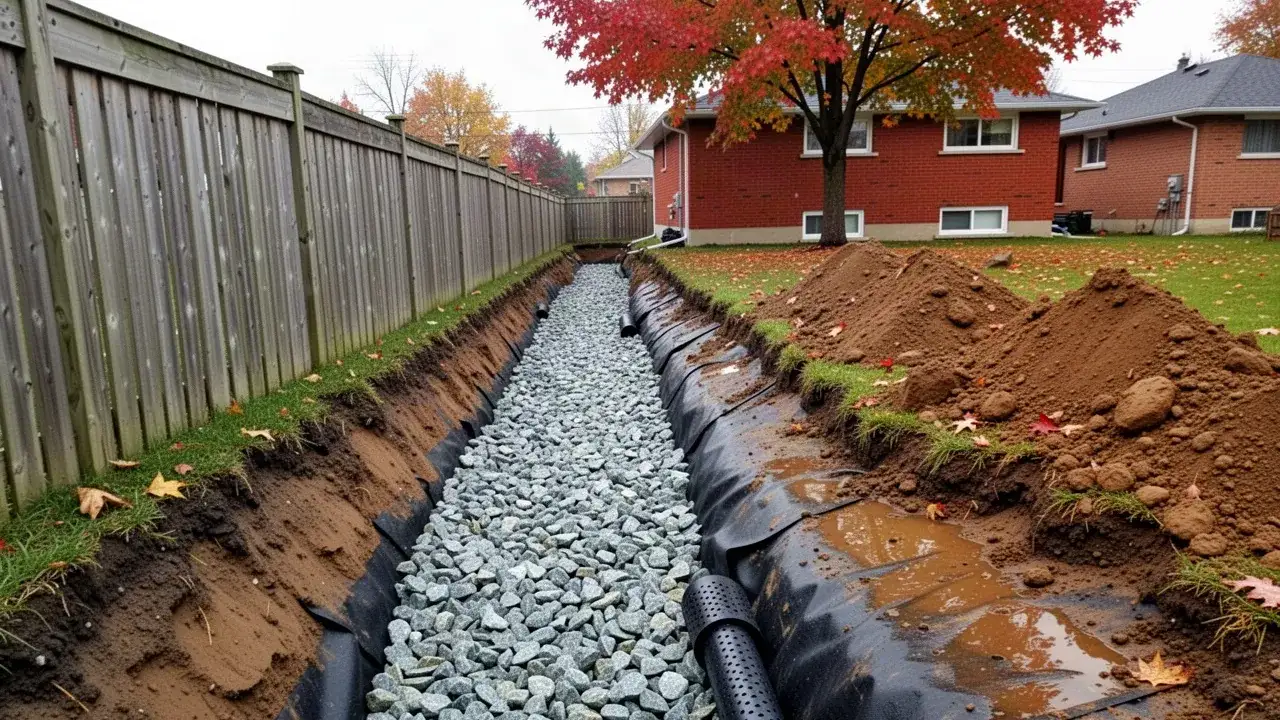
A French drain is a trench lined with non-woven filter fabric, bedded with 19 mm clear stone and fitted with 100 mm (4 in) perforated pipe. It collects groundwater along its whole length and carries it to an outlet.
It suits lawns that never dry out, wet strips along a fence line and the uphill side of a house where water seeps toward the foundation.
Yard Drainage and Swales
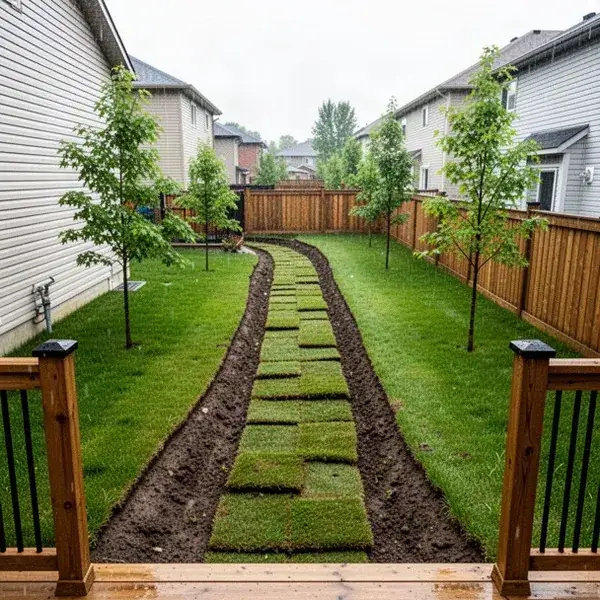
Yard drainage often starts with reshaping the surface so water runs off instead of sitting. A swale is a shallow, sodded channel that carries runoff along a property line or between houses to the street or a rear-yard catch basin.
Swales suit newer subdivisions where the approved lot grading plan relies on side-yard and rear-yard swales that have filled in over time. We often pair this work with grading and levelling around the house to restore the original drainage pattern.
Culvert Installation
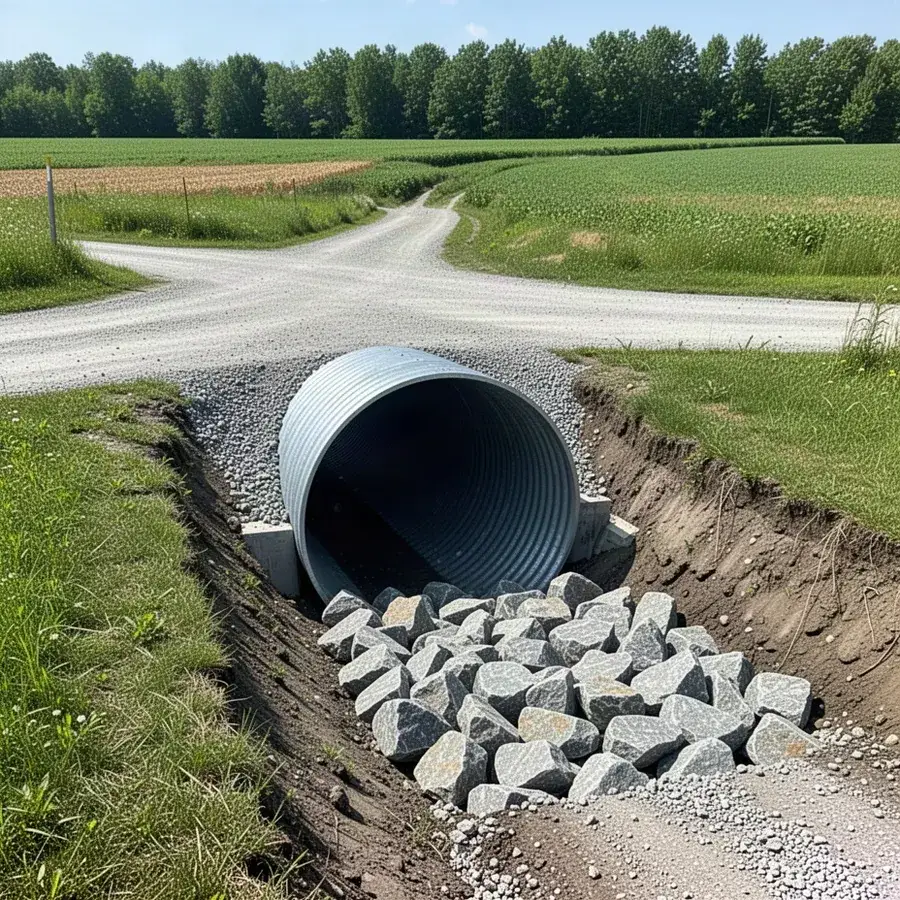
Culvert installation puts a pipe under a driveway entrance, laneway or farm crossing so the roadside ditch keeps flowing. We replace crushed and rusted culverts and install new ones for rural entrances.
Rural homeowners and builders of new country homes are the usual clients. Most townships require a properly sized culvert wherever a driveway crosses a municipal ditch.
Foundation Weeping Tile Replacement
Weeping tile is the perforated drain pipe around the footing of a house that carries groundwater to a sump pit or storm connection. On many older homes in Galt, Preston and central Kitchener, the original clay tile has cracked, shifted or filled with silt.
We excavate along the foundation, remove the failed tile and lay new perforated pipe in clear stone wrapped in filter fabric. The trench is then closed with free-draining granular material through our backfilling service.
What's Causing Water Problems on Your Property?
Most drainage problems trace back to three causes: soil that cannot absorb water, grading that sends water toward the house, and runoff arriving from next door. We check all three during a site visit before recommending any system.
Clay Soil and Poor Infiltration
Clay-rich glacial till underlies large parts of Waterloo Region, and it drains slowly. Rain and snowmelt sit on top or perch just below the sod, leaving lawns spongy for days.
A simple infiltration test tells us a lot. If water in a test hole drops only a few centimetres in an hour, a dry well will fail, and a French drain with a positive outlet is the better choice.
Sandy and gravelly ground on the moraines around Cambridge behaves very differently. That is why we test rather than guess.
Negative Grading and Short Downspouts
Negative grading means the ground slopes toward the foundation instead of away from it. It often develops as the backfill around a house settles over its first few years.
A common target is a fall of about 5 percent, or roughly 15 cm over the first 3 m (6 in over 10 ft), away from the wall. Downspouts that empty right beside the foundation make things worse, so we extend or redirect them at least 2 m (6 ft) out.
Runoff From Neighbouring Lots
When water arrives from a neighbour's yard, the fix is usually restoring a shared swale rather than blocking the flow. Many subdivision lots share drainage swales along rear and side lot lines, and some sit within registered drainage easements.
Fences, sheds, gardens and raised patios built across these swales are among the most common causes of backyard ponding. Restoring the swale profile usually solves the problem for both properties.
Drainage Solutions Compared
The right system depends on where the water comes from and where it can legally go. Here is how the four common options compare on cost and best use.
French Drains
Best for subsurface water, high water tables and long wet strips. Cost is moderate to high because of trench depth, stone volume and restoration.
A French drain needs a positive outlet with enough fall, typically at least 1 percent (1 cm per metre).
Dry Wells and Soakaway Pits
A dry well is a buried pit filled with clear stone or a plastic infiltration chamber that stores water and lets it soak into the ground. It works well for downspout water on sandy and gravelly soils.
Cost is low to moderate. In heavy clay a dry well fills up and stays full, so we only recommend one after an infiltration check.
Catch Basins and Solid Pipe
A catch basin is a grated inlet box with a sump that traps grit, connected to solid pipe that carries water away quickly. It suits surface water from driveways, patios and low corners.
Smooth-walled SDR 28 or SDR 35 PVC pipe resists clogging and is easy to flush. Cost is moderate and depends mostly on the run length to an approved outlet.
Grassed Swales
A grassed swale is the lowest-cost fix for surface flow across a yard. It is shaped with gentle side slopes and a defined low line, then topsoiled and sodded.
Swales need room and a downstream outlet. They cannot fix water that is already moving below the surface.
How We Install a French Drain
We install a French drain in four stages, and most residential runs take one to three days. Before any digging, we request free utility locates through Ontario One Call.
- 01
Finding the Outlet and Fall
Every French drain starts at the outlet, because a drain only works if water has somewhere legal to go. Common outlets are a roadside ditch, a swale, a dry well in suitable soil, or a storm connection where the municipality allows one.
We shoot grades with a laser level to confirm at least 1 percent fall from the high end to the outlet. Yard drains and weeping tile must never be connected to the sanitary sewer.
- 02
Trenching and Filter Fabric
We dig a trench about 300 mm (12 in) wide and usually 450 to 900 mm (18 to 36 in) deep, sized to the water we need to intercept. A mini excavator fits through most backyard gates and leaves a narrow footprint.
The trench is lined with non-woven geotextile. The fabric lets water through while keeping silt and clay fines out of the stone, which is the main reason a French drain either lasts or fails.
- 03
Perforated Pipe and Clear Stone
We bed the trench with 19 mm clear stone, lay 100 mm (4 in) perforated pipe with the holes facing down, then cover it with more clear stone. Long runs or heavy flows may call for 150 mm (6 in) pipe.
Rigid perforated PVC is easier to flush and holds its grade better than flexible corrugated pipe, which makes it the better choice on longer runs. The fabric is then folded over the top of the stone to seal the drain.
- 04
Restoring the Surface
The last step is restoring the surface to match your yard. Most homeowners choose topsoil and fresh sod, while some prefer a visible strip of decorative river rock that also catches surface water.
Excavated clay is hauled away rather than piled back on top. Clay over the drain would seal it off from the surface water it is meant to collect.
Culverts for Rural Driveways and Roadside Ditches
A driveway culvert must be sized for the ditch flow, laid at the ditch grade and protected at both ends. When any of those three is wrong, water backs up behind the driveway or washes out the entrance in the first big storm.
Most rural townships, including Woolwich, Wilmot and Puslinch, require an entrance permit before a new or altered driveway crosses a municipal ditch. Entrances onto regional or county roads go through the Region of Waterloo or Wellington County instead, and each road authority sets its own minimum culvert diameter and length.
- Diameter: commonly 400 to 600 mm (16 to 24 in) for residential entrances, set by the road authority or a flow calculation.
- Material: corrugated steel pipe (CSP) or smooth-walled HDPE.
- Bedding: compacted Granular A under and around the pipe.
- Cover: at least 300 mm (12 in) of compacted granular over the top so traffic does not crush the pipe.
- End protection: rip rap over filter fabric, or sloped and sodded ends, to stop scour.
We set the culvert inverts to match the ditch upstream and downstream, so the pipe neither ponds water nor drops it onto bare soil. Where a ditch outlet is already scouring, we add erosion control such as rip rap aprons and check dams.
Many of these jobs are on country properties north of Waterloo, covered on our page about excavation in Woolwich Township.
Drainage Project Cost Factors
Drainage cost is driven mostly by length, depth, distance to the outlet, materials and how much of the yard needs restoring. As a general Waterloo Region range, most residential French drains fall between about $50 and $120 per linear foot installed, and a single driveway culvert replacement often runs $2,500 to $7,000.
Those are market ranges, not quotes. Your firm price comes from a free site visit where we measure the run, check the outlet and look at access.
- Length and depth: a deeper trench moves more soil and uses more clear stone per metre.
- Outlet distance: a drain that has to reach the front ditch costs more than one that empties into a nearby swale.
- Access: narrow gates, decks, mature trees and finished landscaping slow the work and may need hand digging.
- Materials: pipe type and diameter, fabric, stone volume, catch basins and culvert material.
- Restoration: topsoil, sod, decorative stone or interlock reinstatement.
- Soil haul-away: excavated clay that cannot go back in the trench is trucked off site.
- Permits: township entrance permits for culverts and conservation authority permits near regulated watercourses.
Why Choose Fennex as Your Drainage Contractor
Choose a drainage contractor who diagnoses before digging, knows local soils and carries full coverage. Fennex brings all three.
Diagnosis first. We look at roof runoff, grading, soil and neighbouring lots before quoting, so you are not paying for a drain that only treats a symptom.
Local soil knowledge. More than 40 years of excavation across Cambridge, Kitchener, Guelph and the surrounding townships has shown us how clay till, sandy moraine and high water tables each behave in an open trench.
Credentials that protect you. We are licensed and insured, registered with WSIB and hold an IHSA Certificate of Recognition (COR) for our health and safety program. Most properties in our Cambridge excavation service area are a short drive from our yard.
Where We Provide Drainage Excavation
We provide drainage excavation from our Cambridge yard to homes, farms and businesses within about a 30-minute drive of Cambridge. Choose your community for local permit, soil and neighbourhood details.
Drainage and French Drain FAQs
How much does a French drain cost to install?
Most residential French drains in Waterloo Region cost roughly $50 to $120 per linear foot installed, so a 15 m (50 ft) run often lands between $2,500 and $6,000. Depth, outlet distance, access and restoration move the price the most.
We confirm a firm price after a free site visit.
Where should a French drain empty?
A French drain should empty to a legal, lower outlet: a swale, a roadside ditch, a dry well in soil that drains, or a storm sewer connection where your municipality permits one. It must never connect to the sanitary sewer.
It also cannot simply discharge at the lot line where the water will flow onto a neighbour's property.
Can I drain water onto my neighbour's property?
Generally no. Municipal lot grading rules and Ontario common law both prevent you from concentrating or redirecting water onto an adjoining lot beyond what the approved grading plan already allows.
Natural flow along an existing shared swale is fine, but piping a downspout or sump discharge into a neighbour's yard is not. A registered drainage easement on your lot must also stay open and unobstructed.
How long does a French drain last?
A properly built French drain typically lasts 30 years or more. Lifespan depends mainly on keeping fines out, which is why filter fabric, washed clear stone and a cleanout for flushing matter so much.
Drains built with unwrapped pipe in native clay, or with roots allowed into the stone, can clog in under 10 years.
Book a Drainage Assessment
A drainage assessment is the fastest way to learn why water sits where it does and what it will take to move it. We walk the property, check grades and outlets, and explain your options in plain terms.
Many drainage jobs also involve grading and levelling to correct the slope or erosion control for ditches and banks, and we can quote it all together.
- Fennex Cambridge Excavation Pros
- 725 Briardean Rd, Cambridge, ON N3H 4R6
- +1 226-894-8631
- info@fennexexcavation.ca
- Mon to Sat 7:00am to 9:30pm
Sun 9:00am to 9:00pm