Cambridge Excavation Contractors
Excavation Services in Cambridge, Ontario
Fennex Cambridge Excavation Pros is a Cambridge excavation company run from our own yard on Briardean Road in the north end of the city. For more than 40 years our crews have dug foundations, basements, sewer connections and demolition sites in Galt, Preston, Hespeler and Blair.
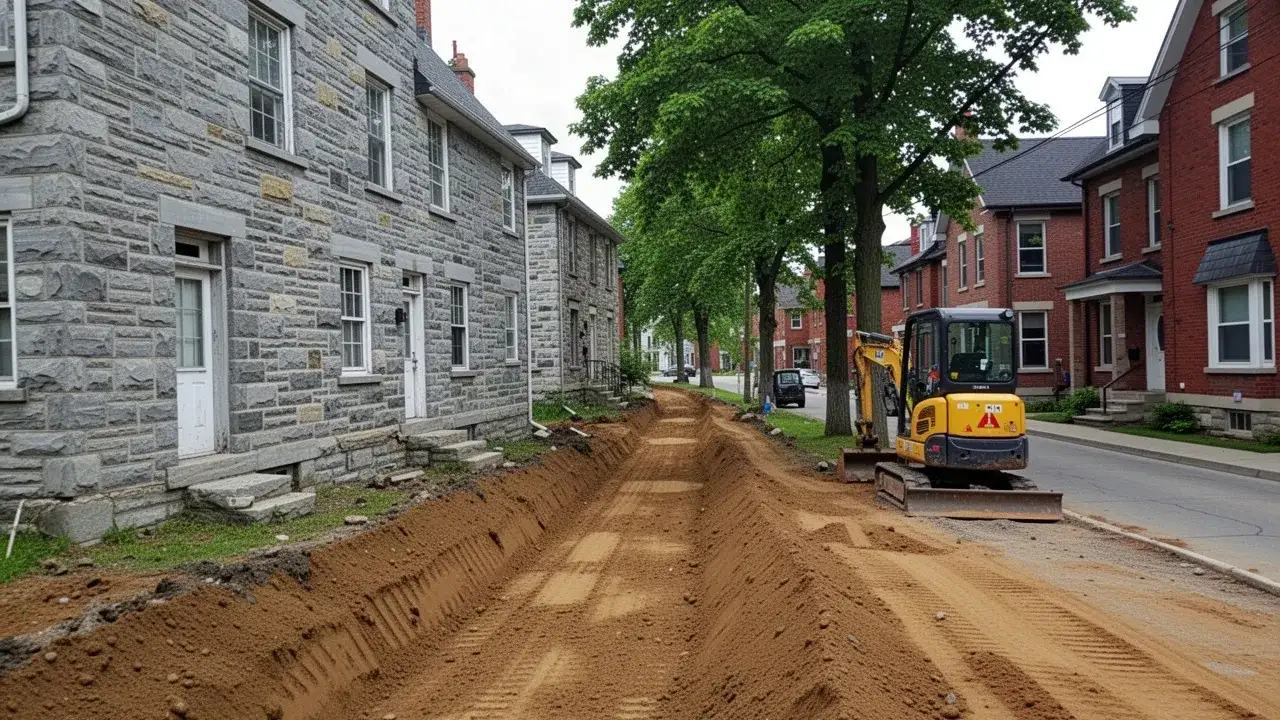
Cambridge is not one kind of ground. A dig beside a stone house on a steep Galt street near the Grand River is a different job from a new-build foundation in a Hespeler subdivision near Highway 401, and we plan each one around its soil, water and access.
We are licensed, insured, WSIB covered and hold an IHSA Certificate of Recognition (COR). Homeowners use us for residential excavation in Cambridge, while builders and property managers call us for commercial excavation and site work across the city.
Excavation Across Cambridge's Three Original Towns
Cambridge was created in January 1973 when Galt, Preston, Hespeler and the settlement of Blair were amalgamated. Each former town still has its own building stock and terrain, and that shapes how we dig in it.
Before we quote, we look at the age of the house, how close the neighbours are, how steep the lot is and how far the property sits from the Grand or Speed River. Those four things decide the machine size, the shoring plan and how much soil has to leave the site.
Galt
Galt is the oldest and steepest part of the city, built on both banks of the Grand River by Scottish settlers in the 1800s. Its downtown and surrounding streets are known for 19th century stone buildings, and many homes sit on rubble or fieldstone foundations.
Lots are tight, side yards are narrow and streets climb out of the river valley. We bring compact equipment, protect walkways with ground mats and plan truck loading so we do not block a hillside street for a full day.
Preston
Preston sits where the Speed River meets the Grand, and it was settled by Pennsylvania German Mennonite families from about 1805. Its core mixes 19th century brick and stone homes with post-war bungalows and later infill.
Lower Preston near the rivers has higher groundwater than the upland streets. Basement and lateral digs there often need a pump on standby, while homes further from the water usually dig dry in sandy soil.
Hespeler
Hespeler grew around Jacob Hespeler's woollen and textile mills on the Speed River, starting in 1845. Today it combines an older village core with large newer subdivisions stretching toward Highway 401.
In the village we see century brick homes that need careful foundation work. In the newer streets the calls are for pools, walkouts, deck footings and yard grading on lots that still follow their original subdivision grading plans.
Blair, East Galt and Southwood
Blair began as a Mennonite mill settlement on the Grand and still has a rural, larger-lot feel. East Galt and Southwood are established neighbourhoods with a mix of post-war bungalows and later homes on roomier lots than downtown Galt.
Bigger lots mean full-size machines can usually get in, which keeps costs down on garages, additions, septic-to-sewer conversions and long drainage runs. Mature trees are the main constraint, so we plan access routes around root zones.
Digging Near the Grand and Speed Rivers
Properties near the Grand and Speed rivers can fall inside areas regulated by the Grand River Conservation Authority (GRCA), and grading, filling or building there needs a GRCA permit before any digging starts. GRCA permits are issued under O. Reg. 41/24, which replaced the older O. Reg. 150/06 in April 2024.
Cambridge has good reason to take this seriously. On May 17, 1974 the Grand River rose to more than 5 m (18 ft), flowed through downtown Galt and flooded low areas such as Preston's Riverside Park, and the dykes and floodwalls along the river today were built in the years that followed.
You can check your lot with the GRCA's planning and permit mapping tools before you commit to a design. If your property is regulated, we build the GRCA review time into the schedule rather than discovering it halfway through.
Near the rivers the water table is often shallow, so basement and footing digs can take on groundwater. We plan for dewatering with sump pits and pumps, and we run discharge through a sediment bag or settling area instead of sending muddy water straight to a storm drain or the river.
Century Homes With Stone Foundations
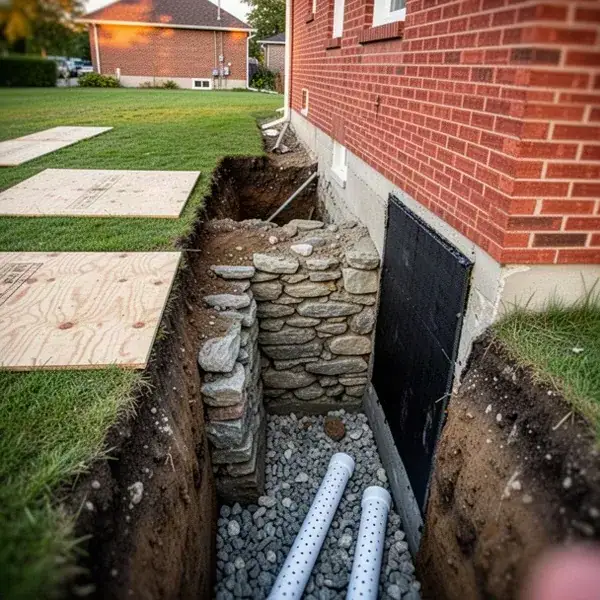
Many older homes in Galt and Preston stand on rubble stone or fieldstone foundations laid with lime mortar, often with shallow footings or none at all. Digging beside or below these walls without a plan can undermine them, so every dig starts with how the wall is supported.
For basement lowering or deep repairs we work in short, alternating sections so most of the wall stays on solid ground at any moment. Our underpinning and shoring work for older Cambridge homes follows the engineer's drawings that the City requires for the building permit.
On the outside, we expose the wall by hand where mortar is loose, then the wall can be repointed, dampproofed and fitted with new perforated weeping tile in 19 mm clear stone. Backfill goes back in light lifts of free-draining granular, because a heavy roller against a 150 year old stone wall can push it in.
Sand and Gravel Under Cambridge
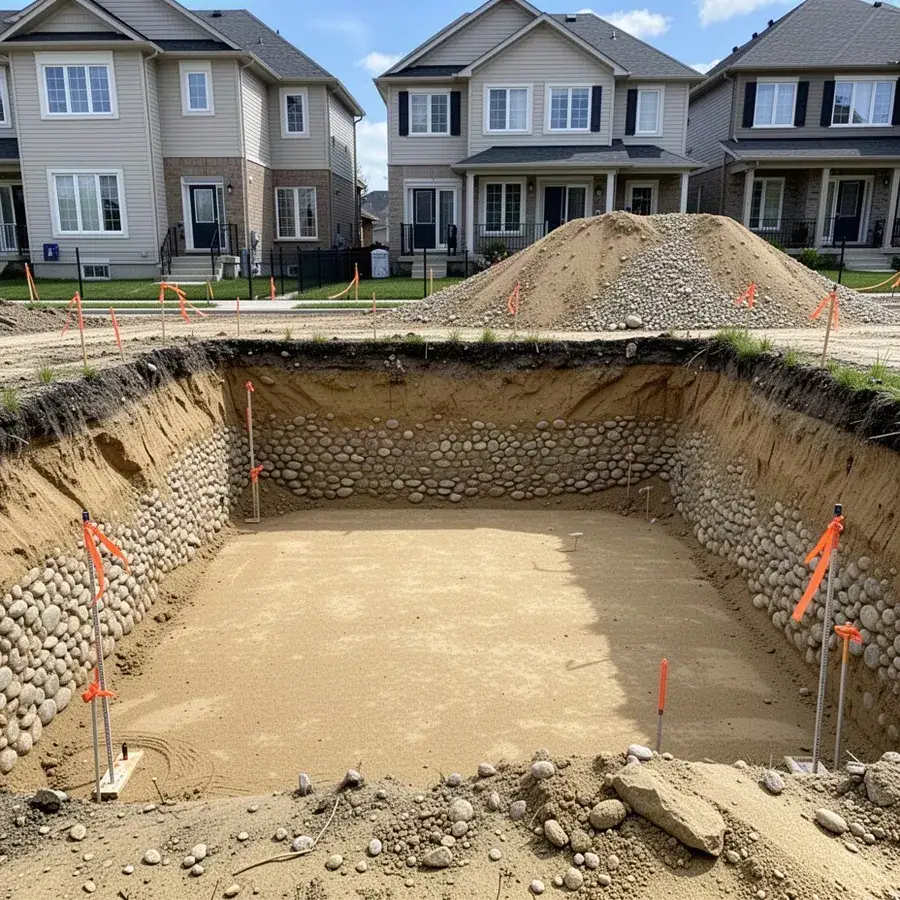
Much of Cambridge is built on loose sand and gravel left by the glaciers, which drains well but caves easily once a trench gets deep. The Paris and Galt moraines run through this area, and their stratified sand and gravel layers sit alongside stony Wentworth Till.
That loose ground is why we never leave an unsupported vertical wall in a Cambridge dig. Ontario's construction regulation, O. Reg. 213/91 excavation rules, requires walls deeper than 1.2 m (4 ft) to be sloped back or supported, and sand usually means wide sloping or a trench box.
The upside is that well-drained sand makes a good base for footings and good backfill. For foundation excavation in Cambridge we confirm bearing at the bottom of the dig, fine-grade it by laser and haul off only the material that will not be reused on site.
City of Cambridge Permits and Bylaws for Excavation Work
Most excavation in Cambridge that supports a structure, moves a lot of soil or changes drainage needs some form of City approval. The three that come up most are building or demolition permits, site alteration permits and lot grading approval.
We tell you at the first site visit which ones apply and what drawings the City will want. Every dig, permitted or not, starts with free utility locates through Ontario One Call.
When Cambridge Requires a Building or Demolition Permit
The City of Cambridge requires a building permit for any structure larger than 10 m² (108 sq ft) or any structure that includes plumbing. That covers new homes, additions, garages, creating additional residential units and septic work, and retaining walls over 1 m (3.3 ft) high may need one too.
New home permits need a lot grading and site service plan with the application, and teardowns need a separate demolition permit. The City of Cambridge building permits page lists what to submit through the City's application portal.
Site Alteration and Fill Rules
Cambridge regulates placing or dumping fill, removing topsoil and changing the grade of land under Site Alteration By-law 23-103, which replaced By-law 160-09. A site alteration permit application includes a grading plan and an erosion and sediment control plan, and larger sites may also need stormwater management design.
The City can hold financial security for erosion control until the site is stable. Soil leaving your property is also covered by Ontario's excess soil regulation, O. Reg. 406/19, so we track where every load goes.
Lot Grading Approvals
Cambridge expects yards to be graded so storm water does not pond, and sump or downspout discharge cannot be aimed at a neighbouring property. New homes are built to an approved grading plan, and changes to an existing lot's drainage pattern can bring that plan back into play.
Pools are a common trigger. A permit is needed for any pool or hot tub that can hold 76.2 cm (30 in) of water or more, and the final inspection checks a compliant fence and lockable gates, so we dig and grade around the approved layout.
Popular Excavation Projects in Cambridge
Three kinds of jobs make up a large share of our Cambridge calls. Each one has a local twist that changes how we plan it.
Basement Lowering and Separate Entrances
Owners of older Galt and Preston homes are lowering basements and adding side entrances to create legal additional residential units. Both need a building permit, and the entrance has to meet the Ontario Building Code for stair width, headroom and drainage.
We dig the stairwell, set the footing base and install a drain at the bottom tied to weeping tile or a sump. See our separate basement entrances and walkouts in Cambridge for how we sequence the cut through the existing foundation wall.
Demolition and Rebuilds
Aging bungalows and fire- or flood-damaged homes on good Cambridge lots are being taken down and replaced. A teardown needs a demolition permit, utility disconnections and a plan for the old foundation, sewer and water services.
Our demolition service in Cambridge sorts concrete, metal and wood for recycling, removes the footings and leaves a clean, compacted pad ready for the new foundation dig.
Driveway Base Prep Before Paving
A paved driveway in Cambridge lasts only as long as the base under it, and frost heave in our winters finds every soft spot. We excavate to firm ground, lay geotextile where needed and build up compacted Granular B and Granular A to the depth the surface needs.
Widening onto the City-owned boulevard needs approval from the City's Transportation Division first. Our driveway excavation and base preparation in Cambridge leaves the base graded and ready for your paving contractor.
Fast Response From Our Cambridge Yard
Because our yard is in Cambridge, most addresses in the city are about 10 to 20 minutes away. Hespeler and Preston are the shortest trips, and downtown Galt and Blair are a little further across the river.
Short travel means less of your bill goes to windshield time, and it means a machine can come back the same day if a job needs a second visit. It also lets us respond quickly when a sewer backs up or a wall starts to move.
We answer the phone 7 days a week. Hours are Monday to Saturday 7:00am to 9:30pm and Sunday 9:00am to 9:00pm, which makes it easier to book a site visit after work.
Our Cambridge Service Area
Fennex crews reach most Cambridge job sites in about 10 to 20 minutes from our yard at 725 Briardean Rd in Cambridge, and we are open seven days a week.
Homeowners and builders here rely on our residential excavation services, while developers, property managers and contractors book our commercial excavation services.
See every community we cover on our excavation service areas page.
Cambridge Excavation FAQs
Do I need a permit to dig in my yard in Cambridge?
It depends on what the dig is for. A building permit is needed for structures over 10 m² (108 sq ft), anything with plumbing, pools that can hold 76.2 cm (30 in) of water and some retaining walls, while bringing in fill or changing grade can fall under the Site Alteration By-law.
Small garden work usually needs no permit, but every dig needs Ontario One Call locates first. We confirm the permit picture at the site visit.
How do I know if my property is in a GRCA regulated area?
Look up your address on the GRCA's online mapping, which shows regulated areas around rivers, creeks, wetlands and valley slopes. Many lots near the Grand and Speed rivers in Galt, Preston and Hespeler are inside these limits.
If yours is, grading, fill or new structures need a GRCA permit under O. Reg. 41/24 before work starts.
How quickly can you get to a job in Hespeler or Galt?
Hespeler is one of the closest areas to our yard, and Galt is usually 15 to 20 minutes away. We can often book a site visit within a day or two of your call.
Actual start dates depend on permits, locates and the season, and we give you a firm date once those are in hand.
Do you handle driveway paving in Cambridge?
We handle the excavation and granular base, which is the part that decides how long a driveway lasts. The asphalt or concrete surface is placed by a paving contractor.
We can work directly with your paver so the base is graded, compacted and ready on the day they arrive.
Get a Quote From Your Local Excavator
Whether it is a stone foundation in Galt, a walkout in Hespeler or a teardown in Preston, you are dealing with a Cambridge crew that knows the ground and the City's rules. Book a free site visit and we will walk the property, flag the permits and give you a clear written quote.
Call us 7 days a week, including evenings until 9:30pm Monday to Saturday.
- Fennex Cambridge Excavation Pros
- 725 Briardean Rd, Cambridge, ON N3H 4R6
- +1 226-894-8631
- info@fennexexcavation.ca
- Mon to Sat 7:00am to 9:30pm
Sun 9:00am to 9:00pm